How To Build A 1,000 Gallon Rainwater System For Under $500: Complete Off-Grid Water Independence
- Citing Statistics or Data
- Referencing Tools or Resources You Mention
- Providing Additional Context
[9] Rainy Filters - DIY Installation Guide (September 2025) - Installation procedures, cleaning frequency recommendations, DIY-friendly confirmation
[10] Rain Brothers - Underground First Flush for Winter Climates (December 2024) - Underground first flush for Ohio winters, freezing risks, warm climate recommendations
[11] Rain Harvesting Supplies - First Flush Mechanisms - Ball and seat mechanism technical details, maintenance procedures
[12] Today's Homeowner - State Rainwater Collection Laws (April 2025) - Colorado 110-gallon limits, state legal variations, Texas/Arizona incentives
[13] World Population Review - Rainwater Harvesting Laws by State (November 2025) - Federal law absence, Rhode Island/Texas/Virginia tax credits, prior appropriation history
[14] World Water Reserve - State Rainwater Harvesting Regulations (January 2025) - Louisiana mosquito prevention requirements, state-by-state legal regulations
[15] Family Handyman - State Rainwater Collection Guidelines (January 2025) - Kansas water rights, Louisiana cistern cover requirements, Ohio potable water regulations
Introduction
You're already sitting under one of the most efficient water collection systems ever engineered—your roof. Every time it rains, thousands of gallons of clean water sheet off those shingles and disappear down the storm drain while you keep paying the water company for the privilege of dependence. Here's the thing nobody tells you: building a legitimate 1,000-gallon rainwater harvesting system doesn't require a contractor, an engineering degree, or a second mortgage. With smart sourcing and a weekend of work, you can achieve actual water independence for under $500. Not a cute little rain barrel that holds enough to water your tomatoes. A real system—1,000 gallons of emergency reserve that gives a family of four roughly 50 days of survival-level water independence. This isn't theory. This is the step-by-step walkthrough of how to build it, where the hidden costs actually hide, what the professionals won't tell you about first flush diverters, and how to avoid the mistakes that turn a $300 system into a $2,500 service call. By the end of this, you'll know exactly what to buy, how to connect it, and what legal tripwires might be waiting in your state. Let's start with the part you can do in the next five minutes.
The 5-Minute Win: Calculate Your Roof's Water Potential
Before you spend a dollar, you need to know if this is even worth doing. The math is stupid simple, and it'll tell you whether your roof can actually deliver the capacity you need. Here's the formula: Roof square footage × 0.623 × inches of annual rainfall = gallons per year. Find your roof square footage from property records or measure it yourself (length × width of your house footprint—don't worry about the slope, the horizontal footprint is what matters). Look up your area's average annual rainfall on any weather site. Multiply those together with 0.623 (the conversion factor that accounts for collection efficiency). Example: A modest 1,000 square foot roof in an area that gets 30 inches of rain per year gives you 1,000 × 0.623 × 30 = 18,690 gallons annually. That's not a typo. Even a small residential roof collects massive volume if you're set up to catch it. Now here's what that number actually means for you: even accounting for losses from debris, evaporation, and system inefficiency, you're looking at roughly 60-70% of that theoretical maximum in real-world collection. That same 1,000-square-foot roof realistically delivers 11,000-13,000 gallons per year. For context, a family of four uses about 400 gallons per day for normal household purposes, or about 5 gallons per person per day at survival minimums (drinking, cooking, basic hygiene). Your roof can potentially cover months of emergency water needs if you've got the storage to catch it. That's your baseline. If your calculation shows you're in a rainfall desert with a tiny roof, you'll know before you start buying tanks. But chances are, you just discovered you've been wasting thousands of gallons every time it rains. Now let's talk about catching it.
The Smart Sourcing Strategy: How to Hit 1,000 Gallons for Under $500
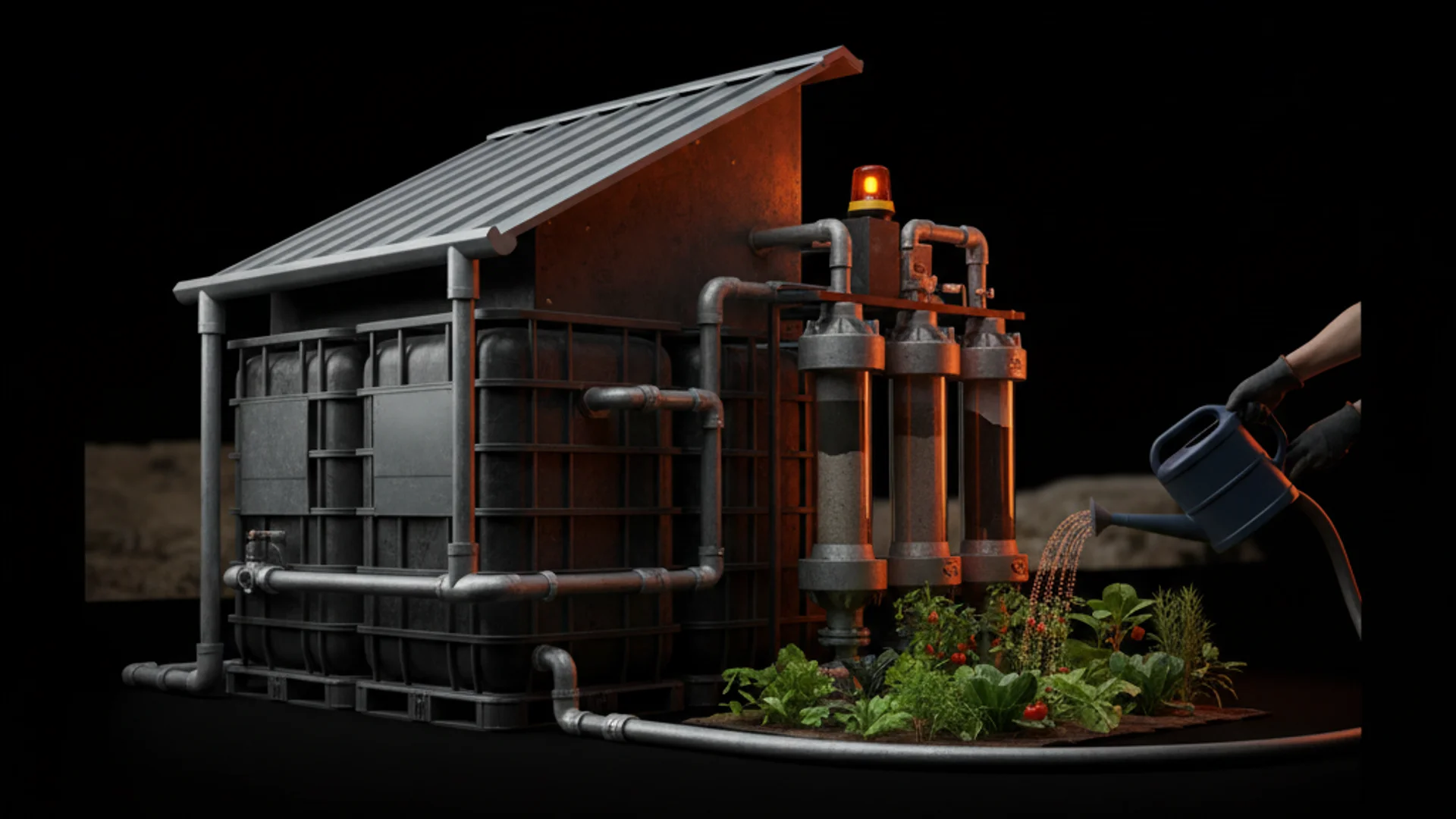
The cost difference between a $2,500 installed system and a $500 DIY build comes down to one thing: sourcing strategy. Professionals buy new retail and charge markup plus labor. You're going to hunt for the industrial surplus sweet spot. Your target: 275-gallon IBC (Intermediate Bulk Container) totes. These are the white or black plastic tanks in metal cages that you've probably seen stacked behind warehouses. They originally held food-grade liquids—everything from juice concentrate to vegetable oil—and businesses replace them regularly even when they're still perfectly functional. Four of these gets you 1,100 gallons. Used, they run $50-$100 each depending on your area. Check Craigslist, Facebook Marketplace, farm supply stores, and food processing facilities. The food-grade designation is non-negotiable—you want containers that held edible products, not chemicals. Here's the due diligence: ask what they previously contained. Some held pickles or olives, and that vinegar smell is nearly impossible to eliminate. You want ones that held neutral or pleasant contents. Inspect for cracks, especially around the valve at the bottom and where the plastic meets the cage. These valves are worth $20-30 to replace, so factor that in if they're damaged. The beauty of IBC totes: they're already stackable, they've got drain valves pre-installed at the bottom, and you can link them together without retrofitting anything. Alternative path if you can't find IBC totes: food-grade 55-gallon drums. You'll need about 18 of them to hit 1,000 gallons, which gets cumbersome fast, but they're often cheaper per unit ($10-$30 used). The linkage is more complex because you're connecting many more vessels, but it's doable with basic PVC plumbing.The rest of your shopping list: - PVC pipe and fittings (¾-inch or 1-inch diameter) for linking tanks: $50-$75 - Gutter modification supplies (if needed): $20-$40 - Mesh screening (1/16-inch for mosquito and debris exclusion): $15-$25 - Hose spigots/ball valves for distribution: $10-$20 - Silicone sealant and Teflon tape: $10-$15 - Concrete blocks or treated lumber for leveling foundation: $30-$60 Total if you source smart: $285-$430 depending on your IBC tote prices and whether you need to modify existing gutters. That's your sub-$500 build to 1,000+ gallons. No contractor. No markup. No bullshit.
The Foundation and Linkage: Where Most First-Timers Screw Up
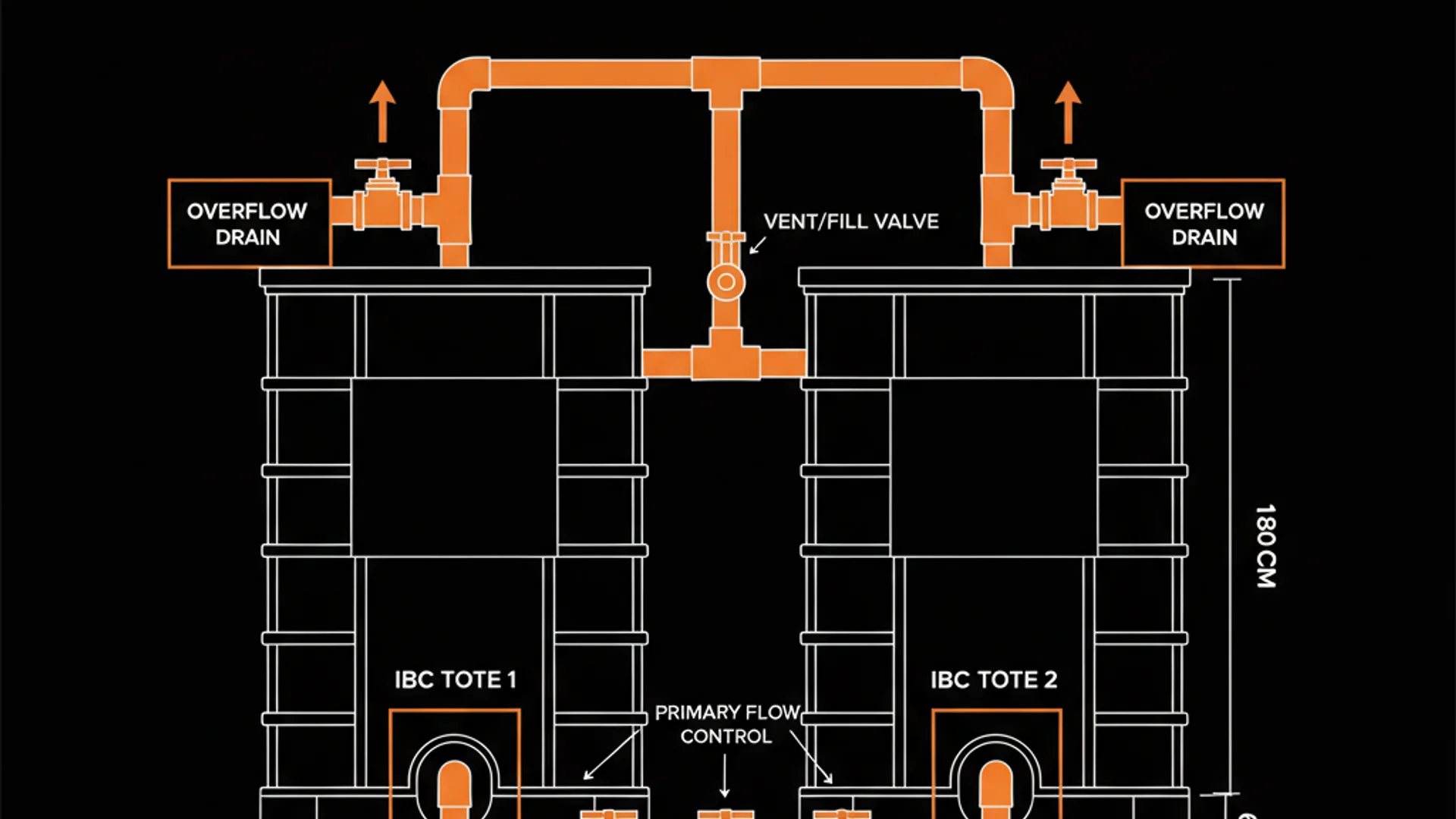
This is the part where enthusiasm meets physics, and physics wins every time. You cannot skip the foundation. I don't care if your yard looks level—it's not level enough. Here's what happens when you don't get this right: you link four 275-gallon totes together, the first rain comes, and one tank overflows while the others are only half full. You just wasted 25% of your capacity because one tank sat three inches higher than the others. Water seeks level. If your tanks aren't level, water will fill the lowest one to the overflow point and dump the excess before the higher tanks get their share. The fix: start with a proper foundation. If you're setting up on concrete (garage slab, patio), check level with a 6-foot level or water level tool. If you're on dirt or gravel, you need a compacted base. The professional move is a crushed stone base 4-6 inches deep, compacted, then topped with concrete pavers or treated lumber frame. The budget move that still works: concrete blocks on compacted ground, checked for level across the entire platform, shimmed where necessary. Tanks are heavy. Water weighs 8.34 pounds per gallon. A 275-gallon IBC tote when full weighs about 2,300 pounds. Four of them together is over 9,000 pounds. Your foundation isn't just about keeping them level—it's about not having them sink into the ground over time and destroy your carefully achieved level plane. Compact that base. Don't skip it. Linking the tanks: you want to connect them at the bottom so they share water level like communicating vessels. This is easier than it sounds. IBC totes have a valve at the bottom (usually a 2-inch camlock or buttress fitting). You can buy camlock adapters that thread into standard PVC pipe. Run a 1-inch PVC line from the valve of tank one to tank two, tank two to tank three, and so on.Use ball valves at each connection so you can isolate a tank if you need to clean or repair it without draining your entire system. The inflow goes into the first tank from your gutter downspout. Each tank needs an overflow at the top in case you get more rain than your total capacity can hold. Position these overflow ports to drain away from your foundation—you don't want 1,000+ gallons worth of overflow eroding the ground under your house. Run a simple PVC overflow pipe that directs water at least 10 feet away from structures. One more thing nobody tells you until it's too late: leave access space between tanks. You will eventually need to clean them, check connections, or replace a valve. Jamming four tanks side-by-side with zero clearance feels space-efficient until you're trying to reach a leaking connection wedged between two 2,300-pound containers. Leave at least 6-8 inches between units. Your future self will thank you.
The First Flush Controversy: Why Professionals Are Ditching Them
This is where the DIY blogs and the professionals start saying opposite things, and you need to understand why before you waste money on equipment that might make your system worse. The theory behind first flush diverters sounds perfect: the initial roof runoff contains bird droppings, dust, pollen, and whatever else has accumulated since the last rain. A first flush diverter captures that dirty first surge and diverts it away from your storage tanks, sending only the cleaner subsequent flow into storage. They cost $20-$60, they use a simple ball-and-seat mechanism with no moving parts, and they seem like obvious cheap insurance for water quality. Most DIY guides recommend them. Now here's what actually happens in the field. At the 2013 American Rainwater Catchment Systems Association national conference, all five panelists agreed they prefer not to use first flush diverters. Keynote speaker Barnabas Kane of TBK Design specifically highlighted his problems with them. Why? Because when they fail—and they do fail—they don't fail safe. A damaged or clogged first flush diverter can divert too much water, potentially all water, away from your storage tanks. You end up with slow fill rates or completely empty tanks while hundreds of gallons sheet off your roof and down the drain. You've created a single point of failure that defeats the entire purpose of your system. The second problem is climate-specific but critical: first flush diverters are only recommended for warm climates. If you're anywhere that sees freezing temperatures, the standing water in the diverter chamber will freeze, expand, and crack the unit. Come spring, you've got a broken diverter that's now dumping all your collection into the waste line.Some installers in places like Ohio use underground first flush systems specifically to solve the freezing problem, but now you're digging trenches and adding complexity and cost that defeats the budget build strategy. So what's the alternative? Robust screening at every entry point. California law actually requires this approach: systems must have a debris excluder and all openings protected by 1/16-inch mesh, including the inlet. This mesh-first strategy stops debris before it enters your system without creating a failure point that can divert all your water away from storage. Practical implementation: install gutter guards on your gutters to catch leaves and large debris. Add a leaf eater or similar debris excluder where your downspout meets your tank inlet—these are cylindrical screens that let water pass through fine mesh while deflecting debris. Screen your tank inlets with 1/16-inch stainless steel mesh. Screen your overflow ports the same way. Total cost: $30-$60 depending on how many entry and exit points you're protecting. No moving parts. No failure points. No freezing problems. Just multiple layers of filtering that require occasional cleaning but won't ever dump your entire collection capacity down a waste pipe. Your water won't be perfectly pristine—you're still going to get some dust and organic matter. But that's what filtration is for if you're planning to use it for potable purposes. The screening approach keeps the big contaminants out without introducing the maintenance headaches and failure modes that have professionals abandoning first flush systems.
Algae, Mosquitoes, and the Things That Will Ruin Your Water
You can build the perfect collection system, hit 1,000 gallons of capacity, and have it all turn into a swamp of mosquito larvae and green slime within a month if you ignore these details. This is where cheap components become expensive mistakes. Algae needs three things: water, nutrients, and light. You control the water and nutrients (that's the whole point of collecting it), so your only leverage point is light. Algae prevention is simple: zero light penetration. This means your containers must be opaque—non-translucent material is non-negotiable. IBC totes usually come in white or black plastic that's already opaque enough, but check by putting a flashlight inside. If you can see the beam from outside, light can get in, and algae will grow. The fix: paint the container with exterior latex paint, wrap it in UV-blocking fabric, or build an enclosure. Wood boxing around your tanks serves double duty—it blocks light to prevent algae and makes your industrial-looking IBC totes less of an eyesore. Simple framing lumber built into a screen fence or enclosure around your tank setup costs $50-$100 in materials and solves both the aesthetic and biological problems at once. If you're in a neighborhood with a homeowners association that gets twitchy about visible rain collection infrastructure, the enclosure is probably mandatory anyway. Mosquitoes are a different threat vector, and in some states like Louisiana, preventing mosquito breeding isn't just good practice—it's legally required. Louisiana law specifically mandates that all rainwater collection containers must be secured and sealed to prevent mosquito breeding and pest access. The consequences aren't just regulatory—mosquitoes breed fast (egg to adult in 7-10 days) and a single tank can become a neighborhood infestation source. The defense is airtight screening at every opening.Your inflow pipe needs 1/16-inch mesh screening. Your overflow pipes need the same. Any access ports or inspection hatches need tight-fitting lids with gaskets or weather stripping to seal gaps. Mosquitoes can get through surprisingly small openings—if you can see daylight through a gap, mosquitoes can navigate it. Check your seals seasonally and replace screening if you find tears or corrosion. If you're using older barrels or drums that have screw-top lids, make sure the threads seal properly. The gasket on these lids degrades over time. Replace them with new rubber gaskets from hardware stores ($2-5 each) rather than assuming the old ones still seal. One loose lid turns your emergency water reserve into a mosquito nursery. Another detail that catches people: the area where your inlet pipe penetrates the tank. If you're drilling through the side of a tank to add a connection, seal it properly with rubber grommets and silicone sealant rated for water contact. Gaps around pipe penetrations are common entry points for both mosquitoes and light. Take the extra ten minutes to seal it correctly the first time instead of troubleshooting an algae bloom or mosquito problem later.
Distribution: Gravity vs. Pumps and What You Actually Need
You've got 1,000 gallons sitting in tanks. Now you need to get it where you're going to use it. This decision point determines whether you're relying on physics or electricity—and whether your system works when the grid is down. Gravity distribution has compelling advantages: no moving parts, zero electricity consumption, and absolute reliability. If your storage sits higher than your point of use, hydrostatic pressure does the work. Every foot of elevation gives you about 0.433 PSI of pressure. That's not much—municipal water runs at 40-60 PSI—but it's enough for low-flow drip irrigation or filling containers. If you can position your tanks on a platform or hillside 10 feet above where you need the water, you've got about 4.3 PSI. That'll run a garden hose at reduced flow or feed a gravity-fed irrigation system. The practical setup: build your tank platform elevated (blocks, hillside, or raised deck structure) and run distribution lines downhill from there. Use ¾-inch or 1-inch PVC for the main line, with ball valves to control flow. Install a spigot or hose connection at your point of use. For emergency household use, run a line to a collection point near your house where you can fill containers. Gravity won't give you shower pressure, but it'll fill a 5-gallon bucket without you carrying it from the tanks. The limitation: gravity only works downhill. If your point of use is higher than your tanks, or if you need actual pressure for sprinklers or household plumbing integration, you need a pump. Pumps range from $150-$300 for systems appropriate to rainwater harvesting. You want a shallow well jet pump or a transfer pump rated for the pressure and flow you need. For garden irrigation, a 1/2 HP pump delivering 40 PSI is plenty.For integration into household plumbing (more on the legal issues with that in a moment), you might want a pressure tank system similar to what well water setups use. The catch: pumps require electricity. If your goal is genuine emergency water independence, you need a way to power that pump when the grid is down. A small solar panel and battery bank (200-watt panel, 100Ah deep cycle battery, charge controller, and inverter) adds $300-$500 to your system cost but gives you grid-independent pumping. Alternatively, a generator works but requires fuel—which defeats the long-term independence goal if you're thinking about extended outages. Most people building for emergency preparedness should design for gravity distribution as primary and pump distribution as a luxury. Position tanks elevated if at all possible. Plan for manual water transport (filling containers at the tank and carrying them) as the ultimate fallback. A pump makes life easier but shouldn't be a single point of failure in your water access plan.
The Legal Minefield: What Your State Isn't Telling You
Here's the thing that catches people after they've spent money and built their system: in some states, the water falling on your roof isn't legally yours. Understanding this before you start can save you from building something you're not allowed to operate. The federal government has zero laws restricting rainwater harvesting. This is entirely a state and local issue, and the variation is wild. Most states actively encourage collection—some even offer financial incentives. But a few have restrictions rooted in water rights law that might limit or complicate your plans. Colorado represents the strictest example. State law allows residents to collect rainwater in two rain barrels with a combined capacity of 110 gallons maximum. That's it. The water can only be used on the property where collected and only for outdoor purposes. The reasoning traces back to prior appropriation doctrine—the legal framework that says water is already allocated to downstream users, so capturing it before it reaches the watershed is essentially theft from those who hold water rights. This is Old West law applied to modern homesteading, and whether it makes sense in the context of residential rooftop collection is debatable, but it's the law. Before you start buying tanks, check your state regulations. The optimistic side: states like Texas, Arizona, Rhode Island, and Virginia don't just allow collection—they provide tax credits or exemptions for equipment purchased for rainwater harvesting. Tucson specifically offers up to $2,000 in rebates for cistern installations. If you're in one of these states, you might be able to offset a significant chunk of your build cost through incentive programs. Louisiana allows collection but requires containers to be secured and sealed for mosquito prevention—essentially mandating the screening and sealing practices we've already covered.Ohio regulates potable use (water intended for drinking) more strictly than non-potable collection. Kansas ties collection to property water rights. The pattern: outdoor use (irrigation, livestock, washing) is broadly permitted. Potable use (drinking, cooking, bathing) triggers more regulation and often requires filtration, testing, or permitting. If your goal is emergency backup water for drinking, check whether your state or county requires system approval or periodic water quality testing. Some jurisdictions mandate that potable rainwater systems include specific filtration stages or disinfection methods (UV treatment, chlorination). Local ordinances add another layer. Your city or county might have rules your state doesn't, especially regarding system visibility, placement, structural requirements for tank platforms, or plumbing integration. Check with your local building department if you're planning anything beyond basic rain barrels. Some areas require permits for systems over a certain capacity or for any plumbing integration into household water lines. The annoying reality: you might build a perfectly functional 1,000-gallon system only to discover your HOA bans visible tanks or your city requires a permit you didn't pull. Do the legal homework before the hardware shopping. Look up "[your state] rainwater harvesting laws" and "[your city/county] rainwater collection ordinance." Call your local building department if anything is unclear. Five phone calls now beats a code enforcement visit later.
Filtration and Potable Use: When You're Not Just Watering Gardens
Everything we've covered so far gets you safe collection and storage for outdoor use—irrigation, washing equipment, livestock, toilet flushing. If you want to drink it, cook with it, or bathe in it, filtration and treatment become non-negotiable. The screening and debris exclusion we covered earlier is pre-filtration—it keeps the big stuff out. For potable use, you need to address bacteria, viruses, parasites, dissolved contaminants, and anything else that survived the trip from sky to roof to tank. Your roof has bird droppings, decomposing leaves, atmospheric pollutants, and whatever else the wind deposited. That's going into your water even with good screening. Filtration systems for potable rainwater use cost $75-$200 for basic setups. A multi-stage approach is standard: sediment filter (5-micron or finer) to catch particulates, carbon filter to remove taste/odor issues and some chemicals, and then either UV sterilization or chemical disinfection to kill pathogens. UV sterilization systems run $150-$300 and use ultraviolet light to destroy bacteria, viruses, and parasites without adding chemicals. They require electricity and periodic bulb replacement (annually, $50-$80), but they're effective and don't alter water taste. Chemical disinfection (chlorine or iodine tablets) is the low-tech backup that works without power but affects taste and requires careful dosing. The CDC position on rainwater for drinking: treatment is essential. They don't say don't do it—they say don't do it without proper filtration and disinfection. Giardia, Cryptosporidium, and bacteria like E. coli are common in untreated rainwater, especially in systems collecting from roofs where animals have access. Maintenance becomes a real consideration with potable systems. Filters need replacement on schedules ranging from every three months to annually depending on usage and water quality.Annual maintenance costs can run $100-$500 if you're hiring it out, or $50-$150 if you're doing filter replacements yourself. This isn't a set-and-forget system if you're using it for drinking water—you need to track filter life, test water quality periodically (basic bacteria test kits run $15-$40), and stay on top of UV bulb replacement. Testing matters more than people assume. Just because your water looks clear doesn't mean it's safe. Bacteria and parasites are invisible. Test initially to establish a baseline, then retest every 6-12 months or after any system modification, major storm, or lengthy period of non-use. Local health departments sometimes offer free or low-cost water testing, or you can mail samples to certified labs ($50-$150 for comprehensive testing including bacteria, pH, minerals, and contaminants). The honest assessment: if you have access to municipal water and you're building rainwater collection purely as emergency backup, you might not need full potable treatment right now. Store the water, use it for non-potable purposes during normal times, and keep a quality camping water filter (Sawyer, LifeStraw, or Katadyn) on hand for emergency drinking water treatment. These filters cost $20-$100, last for thousands of gallons, and turn questionable water into potable water without electricity or complex installation. It's not a replacement for a proper whole-house filtration system, but it's a pragmatic backup that keeps your initial build cost down while still giving you emergency drinking water capability.
Frequently Asked Questions
Can I really build a 1,000-gallon system for under $500, or is that just for materials without all the hidden costs?
The $500 figure is realistic but depends entirely on your sourcing. If you find used 275-gallon IBC totes at $60-$80 each (four totes = 1,100 gallons), add $100-$150 in PVC plumbing, $30-$60 for screening materials, $30-$60 for foundation blocks or lumber, and $20-$40 for valves and sealants, you're at $340-$470 total. The variable is the IBC tote price—these range from $50 in rural agricultural areas to $150+ in cities where they're harder to find. If you can't source cheap totes and have to buy new retail, costs jump dramatically (new 275-gallon tanks run $400-$600 each). The sub-$500 build is absolutely achievable with patient sourcing, but it's not an Amazon Prime next-day project. Expect to spend 2-4 weeks hunting for used tanks at the right price.
Is rainwater harvesting legal in my state, and how do I find out without calling attention to myself?
The federal government has no restrictions on rainwater harvesting—this is entirely state and local regulation. Most states actively encourage it, and many offer tax credits or rebates. The exceptions you need to watch for: Colorado limits collection to 110 gallons for residential use. Some Western states with prior appropriation water rights have restrictions tied to property water rights. To research quietly, search '[your state] rainwater harvesting laws' and check your state's water resources department website—these usually have plain-language guides. For local ordinances, search '[your city/county] rainwater collection ordinance' or check your municipality's code of ordinances (usually available online). If you want to stay completely off the radar, use a library computer or VPN for searches. Most places have zero restrictions on collection for outdoor use like irrigation. Restrictions typically only kick in if you're integrating into household plumbing or claiming it for potable use.
What's the real-world water quality like from a roof collection system—should I be worried about drinking it even with filters?
Unfiltered rainwater from a roof collection system contains bird feces, decomposing organic matter, atmospheric pollutants, and bacteria. It's not safe to drink without treatment, period. With proper multi-stage filtration (sediment filter, carbon filter, and UV sterilization or chemical disinfection), rainwater can meet or exceed municipal water quality standards—there are no treatment chemicals like chlorine or fluoride, and no pipe contamination like lead from old infrastructure. The concern is maintenance discipline. If you stay on top of filter replacements, UV bulb changes, and periodic water testing (every 6-12 months), filtered rainwater is safe for drinking. If you're lazy about maintenance, you're creating risk. Many people use rainwater systems for outdoor use and emergency backup only, keeping a portable camping filter (Sawyer Squeeze, LifeStraw) as the emergency drinking water method rather than installing a permanent whole-house filtration system. This keeps costs down and reduces maintenance burden while still giving you potable water capability when you need it.
How long can I store rainwater before it goes bad, and do I need to rotate it like food storage?
Water doesn't expire, but it can become contaminated or develop algae growth if storage conditions aren't right. In a properly sealed, opaque tank with mosquito-proof screening and no light penetration, rainwater can remain usable for 6-12 months or longer without significant degradation. The key factors: prevent algae (block all light), prevent mosquito breeding (seal all openings with fine mesh), and prevent contamination (don't let debris or animals access the tank). You don't need to rotate water on a schedule the way you rotate food. Instead, use your system actively—water gardens, wash equipment, flush toilets—and let rain naturally refresh your supply. Stagnant water that sits unused for years can develop taste/odor issues even if it's technically safe, so periodic use is better than treating it as sealed long-term storage. If you want dedicated long-term emergency water storage that never gets touched, buy dedicated water storage containers with biocide treatment, seal them, and store them separately from your active rainwater system.
What happens to my system in winter if I live somewhere with freezing temperatures?
Freezing temperatures can destroy rainwater systems if you don't prepare for them. Water expands when it freezes, which cracks tanks, splits pipes, and destroys valves. If you're in a freeze-prone area, you have three options: (1) Drain the system completely before winter and don't collect during freezing months—this is the simplest approach but means no water collection for part of the year. (2) Insulate tanks and pipes heavily and use heat tape on pipes to prevent freezing—this works but requires electricity and active management. (3) Move collection infrastructure indoors or underground where it stays above freezing—this is the professional approach used in cold climates but adds significant cost and complexity. Most budget DIY systems in cold climates use the drain-down approach: disconnect downspouts from collection tanks before the first freeze, drain all water from tanks and pipes, and reconnect in spring. IBC totes themselves can typically handle freeze/thaw cycles when empty, but never leave water in them if temperatures will drop below freezing. First flush diverters specifically are not recommended for cold climates because the standing water in them freezes and cracks the unit even if you drain your main tanks.
Should I get a permit for this, and what happens if I build it without one in a place that requires permits?
Permit requirements vary dramatically by location. Most jurisdictions don't require permits for simple rain barrel systems under 200-500 gallons used for outdoor irrigation. Larger systems, systems with pumps, systems integrated into household plumbing, or systems on permanent structures often trigger permitting requirements. Check with your local building department—call anonymously if you want, frame it as 'I'm considering this project and wondering what the rules are.' If your area requires a permit and you build without one, the realistic risks are: (1) a code enforcement visit triggered by a complaint (visible tanks, nosy neighbors), (2) complications if you try to sell the property (unpermitted improvements sometimes appear in inspections), and (3) potential insurance issues if unpermitted work contributes to property damage (like a tank collapse). Most places are hands-off about residential rainwater collection because it reduces stormwater load on municipal systems, but if you're building a large system or anything involving structural platforms or electrical pumps, doing the permit homework is worth the hassle. The fine for unpermitted work typically exceeds the permit cost, and you might be forced to remove the system or bring it up to code retroactively.
Conclusion
You now have the blueprint for genuine water independence—not the aspirational Pinterest version with decorative rain barrels that hold 50 gallons, but a working 1,000-gallon system that gives you months of emergency capacity. The difference between reading this and having actual water security is execution. Start with the five-minute win: calculate your roof's collection potential so you know this is worth doing. Then spend a week sourcing used IBC totes. Everything else follows from those two steps. The broader context matters here. Municipal water systems are centralized infrastructure vulnerable to grid failure, contamination events, cyber attacks, and simple bureaucratic dysfunction. The Texas freeze in 2021 left millions without water not because water stopped existing, but because the systems that processed and delivered it failed. That's the nature of dependence—someone else's failure becomes your emergency. Building your own collection capacity isn't prepper paranoia; it's basic infrastructure redundancy. When you control 1,000 gallons independent of any outside system, you've bought yourself breathing room that most people won't have when things go sideways. And if you're reading this on SurvivalBrain, you already understand the value of systems that work when everything else doesn't. The waitlist for SurvivalBrain's Q1 2026 launch is open at https://survivalbrain.ai/#waitlist—$149 early access pricing ($50 off the $199 standard). Offline AI that works when the internet doesn't, just like your rainwater system works when the taps don't. Independence compounds.
Get Early Access to Uncensored Offline AI
Join the waitlist for SurvivalBrain launching Q1 2026. Early supporters lock in $149 lifetime pricing (save $50).
Lock In $149 Pricing