EMP-Proof Your Electronics: The Science-Based Guide To Protecting Critical Devices From Electromagnetic Threats
Introduction
You're scrolling through preparedness forums, and every third post is someone asking about Faraday cages. Half the responses are confident and wrong. Someone insists you need to ground your cage (you don't). Another swears their cell phone test proves their setup works (it doesn't). A third guy wrapped his radio in foil once and thinks he's bulletproof (he's probably not). Meanwhile, the actual threat—the physics of electromagnetic pulses and what they do to electronics—gets buried under mythology, half-remembered Hollywood scenes, and gear recommendations from people who've never tested anything. Here's what actually matters: an electromagnetic pulse, whether from a solar storm, a high-altitude nuclear detonation, or a briefcase-sized weapon, can permanently destroy the electronics you're counting on to survive an emergency. The Carrington Event of 1859 set telegraph equipment on fire and shocked operators. A repeat today could cost the U.S. economy up to $2.6 trillion. Nuclear EMP weapons can fry unprotected solid-state electronics across entire regions in less than one hundredth of a second. And flux compression generators—non-nuclear EMP devices—have shrunk from several feet long to the size of a beer can. But protection isn't complicated. It's physics, and the physics has been solved since Michael Faraday figured out how to cancel electric fields in the 1800s. You don't need a $5,000 military-spec container. You don't need to bury anything or connect it to a ground rod. You need a continuous conductive surface with no gaps, some cardboard to keep your devices from touching metal, and a way to test whether you actually built the thing right. This guide will show you how to do it—starting with something you can finish in the next ten minutes.
The Threat Isn't What You Think It Is (And That's Why Most Protection Fails)
EMP threats come in three flavors, and confusing them will wreck your protection strategy. Solar flares—coronal mass ejections like the Carrington Event—generate electromagnetic energy with wavelengths hundreds of meters long. They induce currents in long conductors like power lines and transformers, which is why they threaten the electrical grid but leave your unplugged smartphone alone. A Carrington-class storm happens roughly once every 150 years, and we're overdue. Nuclear high-altitude electromagnetic pulse (HEMP) is the inverse threat. Detonate a nuclear weapon 25 miles up, and it creates a three-phase electromagnetic burst. The first phase—E1—lasts less than one hundredth of a second but delivers an intense radiated pulse that will permanently damage unprotected solid-state electronics. The wavelengths are short—several inches—which means they couple directly into small devices. Your phone, your radio, your car's ignition system. HEMP threatens electronics but poses less danger to the overall grid because it doesn't have the sustained, long-wavelength energy needed to induce massive currents in high-voltage transmission lines. Then there are non-nuclear EMP weapons. Flux compression generators used to be several feet long. Now they're the size of a beer can, and they can produce an EMP shock wave from a device small enough to fit in a briefcase. The wavelengths can be as short as a few centimeters. This isn't nation-state stuff anymore—this is something a determined adversary with moderate resources can build. Here's the critical insight most people miss: an EMP attack would threaten smaller electronics but would pose less of a danger to the overall grid, while a coronal mass ejection does not threaten small electronics lacking the long conductors that characterize the grid. The threats are inverse images of each other.If you're protecting a handheld radio, you're defending against HEMP and non-nuclear devices, not solar flares. If you're worried about the transformer down the street exploding, that's a solar storm problem, not an EMP weapon problem. Your Faraday cage protects the first category—small electronics with short conductors. It does nothing for the grid. And here's what's actually vulnerable in that first category: telecommunications equipment, computer systems, radar, electronic warfare gear, satellite receivers, and anything with microchips managing ignition or control systems. Cars with electronic ignition are vulnerable. Ham radios, walkie-talkies, battery chargers, solar charge controllers—all vulnerable. Some analysts argue that limited testing shows modern commercial equipment may be surprisingly resistant, but other analysts maintain that past military testing was flawed or incomplete, leading to faulty conclusions. The safe assumption is that if it has a chip and you need it to work after an EMP event, it needs shielding.
Why Faraday Cages Work (And Why Most DIY Attempts Don't)
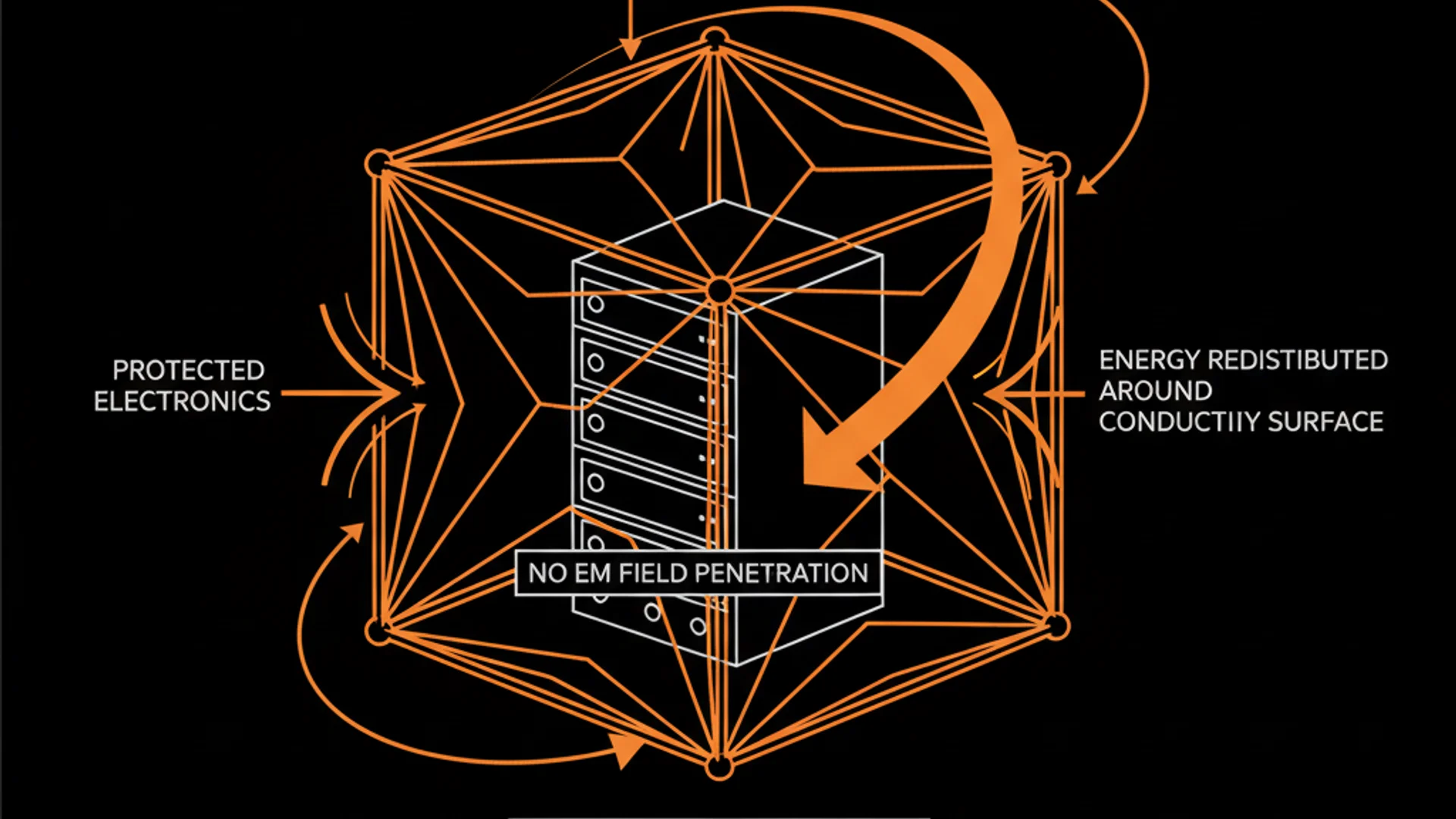
A Faraday cage doesn't block electromagnetic energy like a wall blocks a bullet. It redistributes it. When an external electric field hits the conductive surface of the cage, it causes the electric charges within that material to rearrange themselves in a way that cancels the field's effect inside the cage. The energy flows along the surface rather than penetrating through. This is field cancellation, and it's the reason a car struck by lightning doesn't electrocute the passengers inside (assuming they're not touching metal and the tires provide some insulation from ground current). The goal isn't 100% blockage—it's attenuation. You're reducing electromagnetic energy to levels that won't harm electronics, measured in decibels (dB). Faraday cages can achieve up to 100 dB attenuation and block 99.999% of electromagnetic signals per IEEE standards. For context, every 3 dB of attenuation cuts the signal strength in half. A cage providing 30 dB of attenuation reduces the signal to one-thousandth of its original strength. That's usually enough. The military standard—MIL-STD-461G—provides test methodology and screening levels to determine whether a device can survive radiated and conducted EMP exposure, and it's the benchmark against which serious protection efforts are measured. But here's where DIY attempts fall apart: gaps. Nuclear EMPs have wavelengths as short as several inches. Non-nuclear EMP devices have wavelengths as short as a few centimeters. If your cage has a gap—at a seam, around a lid, where two pieces of metal meet—and that gap is comparable to the wavelength of the incoming energy, the energy will leak through.Mesh screen works fine for solar flares with their hundred-meter wavelengths, but it's useless against HEMP or compact EMP weapons.You need a continuous conductive surface, not a grid of holes.This is why the classic "wrap it in aluminum foil" advice is dangerous unless done with extreme care. One pinhole, one tear where the layers don't overlap perfectly, one spot where the foil crinkles and creates a gap—and you've just built a shiny paperweight instead of a shield. Wrapping devices in three or more layers ofheavy-duty aluminum foil with each layer separated by non-conductive material (like plastic wrap or wax paper) can offer decent short-term protection, but only if every layer is continuous and every seam overlaps by several inches. Thegalvanized steel trash can method works because it gives you a single continuous conductive shell with a lid that overlaps the body. Metal ammo cans work for the same reason—and they come with rubber gaskets that help close gaps. Metal filing cabinets can work if the drawers close tightly. The pattern here is: continuous metal shell, tight-fitting closure, no gaps you can see light through. The protection is only as good as the weakest point in your construction. If there's a gap, the cage fails.
Build Your First Faraday Cage in 10 Minutes (The Trash Can Method)
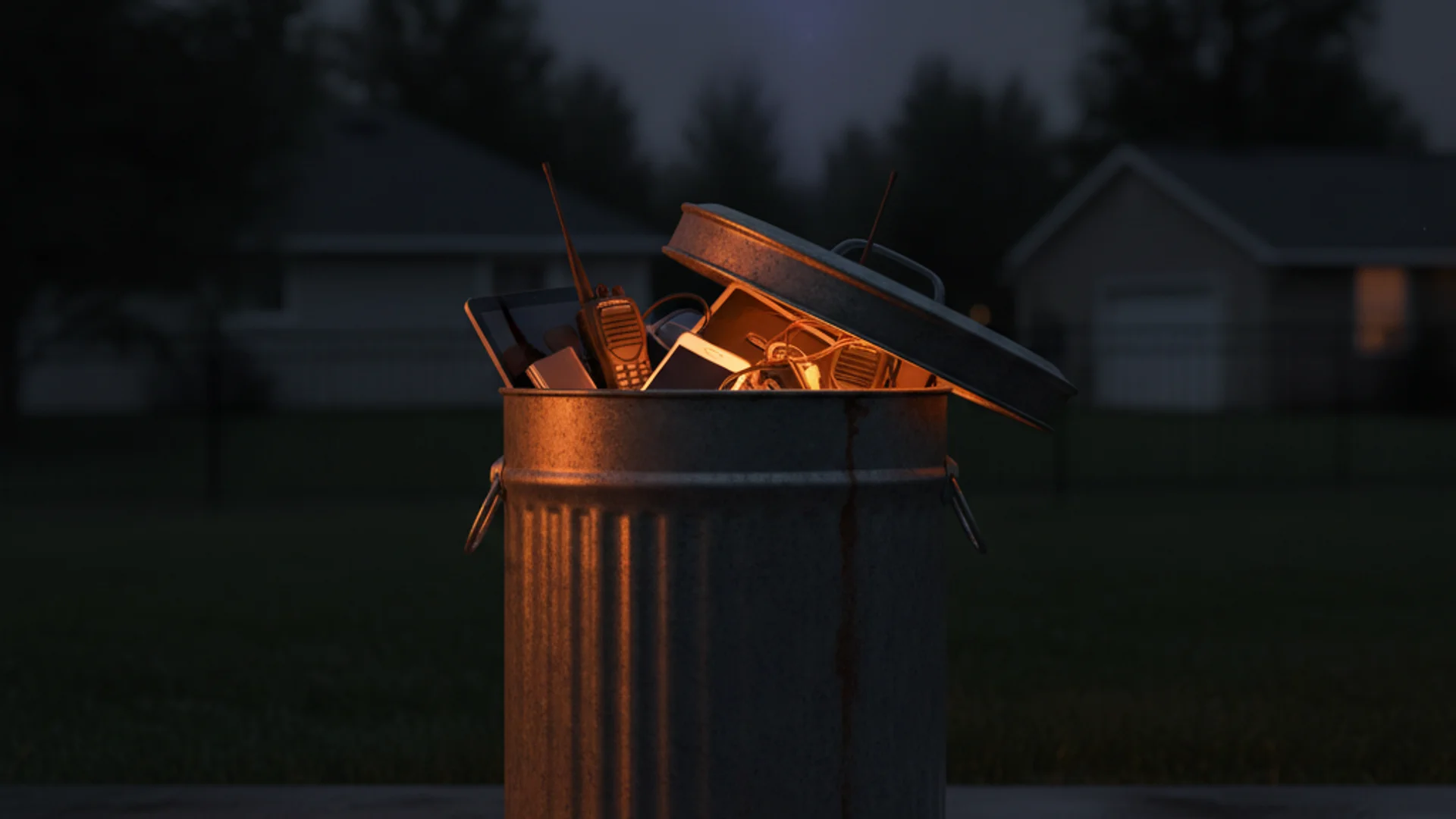
You need four things: a galvanized steel trash canwith a lid, heavy-duty aluminum foil, cardboard, and aluminum tape. Total cost: under $40. You probably have most of this already. Start with the trash can. It needs to be metal—galvanized steel is ideal because it's conductive, cheap, and available at any hardware store. Avoid painted or powder-coated cans if possible, but if that's all you have, you can scrape the paint off the rim where the lid makes contact. The lid needs to overlap the body of the can when closed. No gaps. If you can see light through the seam when the lid is on, the seal isn't good enough. Line the inside with cardboard. Cut pieces to fit the bottom and sides, creating a non-conductive barrier between the metal can and whatever you're storing inside. This is critical: if your electronics touch the conductive surface, you create a path for induced current to flow directly into the device. That's the opposite of protection. Some people use foam, bubble wrap, or folded cloth—anything non-conductive works. Cardboard is cheap, easy to cut, and effective. Wrap your devices in aluminum foil. Use heavy-duty foil, and wrap each device completely—no exposed areas. Then wrap a second layer, making sure the seams of the second layer don't line up with the seams of the first. If you're feeling cautious, add a third layer. Between each layer, add a thin non-conductive separator (plastic wrap, wax paper, or even plain paper). This prevents the foil layers from shorting against each other and gives you redundancy—if one layer tears, the others still provide shielding. Place the wrapped devices inside the cardboard-lined trash can. Make sure nothing is touching the metal. Close the lid. If you want extra security, run aluminum tape around the seam where the lid meets the can.This creates a more continuous conductive path and reduces the chance of gaps.You're done. You just built a functional Faraday cage.What do you put in it?Start small.A handheld radio, a flashlight, spare batteries, a solar charge controller, aUSB power bank. Don't put anything in the cage that you need to use right now—the whole point is to have a backup that survives when everything else gets fried. If you have two of something critical (like a handheld radio), put one in the cage and use the other daily. If you have important data, put a USB drive with backups in the cage. If you rely on a particular device during emergencies, buy a spare and cage it. One important note: electronics with batteries can corrode or leak over time, and sealed metal containers can trap moisture. If you're storing devices long-term, consider adding a silica gel packet to absorb humidity, and check your cage every six months. Swap out batteries if needed. This isn't set-it-and-forget-it—it's set-it-and-check-it-occasionally.
Testing Your Cage (And Why The Cell Phone Test Is Bullshit)
You've built the cage. Now you need to know if it actually works. The internet is full of advice: put your cell phone inside, close the lid, and try to call it. If it doesn't ring, your cage works. If it rings, your cage failed. Simple, right? Wrong. Whether or not a cell phone rings inside the cage does not indicate if the cage provides adequate protection from an EMP. Cell phones don't transmit or receive at the right frequency to check for EMP shielding. An EMP has energy from about 100 kHz to 1 GHz, but only the high-frequency energy—hundreds of megahertz—couples into small electronics. Testing at 462 or 467 MHz is an excellent indicator of EMP shielding effectiveness. Cell phones, depending on the carrier and technology, operate anywhere from 700 MHz to 2.6 GHz. They're in the wrong frequency range, and even if they were in the right range, there's no way to know how strong the signal is outside the cage or how sensitive your particular phone is to receiving a weak signal. You're not testing shielding effectiveness—you're testing whether your phone can pick up a signal that may or may not be strong enough to reach it. Two-way radios transmit at 462 or 467 MHz, which is perfect for checking EMP shielding. But they transmit too much power and are too sensitive to be used reliably without modification. Even some of the best Faraday cages will fail to block a good two-way radio signal completely. If your cage blocks the radio, great—you've got excellent shielding. But if the radio still receives a faint signal, that doesn't mean the cage is useless. It might still provide 30 or 40 dB of attenuation, which is enough to protect against most EMP threats. You just can't tell from a pass/fail test.Professional shielding effectiveness testing requires a signal generator, amplifier, broadband antenna, spectrum analyzer, and a shielded room so you're not broadcasting illegally. That equipment could easily cost $250,000. You're not doing that. So what can you actually do? A modified two-way radio test gives you a rough indication. Put a two-way radio inside your cage, close it, and try to reach it with another radio from a few feet away. If the radio inside doesn't receive anything, your cage is probably pretty good. If it receives a weak, broken signal, your cage has some shielding but probably needs improvement—check for gaps, add more foil layers, or improve the seal around the lid. If the radio inside receives a clear signal, your cage is failing and needs significant fixes. Better yet: nest your protection. If you have a cage that provides just 3 dB of shielding and put that cage inside another cage, you have 6 dB. Attenuation is additive when you layer shields. This is why serious preppers use nested commercial Faraday bags inside metal containers. Wrap your device in foil (first layer), put it in a Faraday bag (second layer), put that bag inside a cardboard-lined ammo can (third layer). Each layer multiplies your protection. It's much easier to add another 3 dB of isolation than to build a single perfect cage. And here's a myth that needs to die: Faraday cages for EMP protection do not require grounding. Grounding may actually create a path for induced currents to enter. A Faraday cage does not work on the same principle as a lightning rod. Lightning is electrical energy that induces some electromagnetic energy, not the other way around. A Faraday cage works because electromagnetic energy induces current into the conductive shell, and that current flows along the surface and dissipates.You don't need to connect your trash can to a ground rod in your backyard. Just build it right and close it tight.
What To Protect First (And What You're Wasting Time On)
You have limited space in your Faraday cage and a limited budget for backups. Prioritize ruthlessly. The goal isn't to save every electronic device you own—it's to make sure you have the critical tools you need to communicate, navigate, and maintain power after an EMP event when everyone else's gear is bricked. Communications equipment comes first. Handheld radios, walkie-talkies, ham radios—these are your post-EMP lifeline. If the grid goes down, if cell towers are dead, if the internet is gone, radio is how you stay in touch with family, coordinate with neighbors, and get information about what's happening beyond your immediate area. A basic handheld two-way radio costs $30. Buy two, put one in your cage. If you're licensed for ham radio, your HF rig is irreplaceable—get a backup antenna tuner, spare coax, and a handheld VHF/UHF radio as a minimum backup. If you're not licensed, get licensed. When everything else fails, amateur radio operators are still talking. Power systems are second. Batteries, solar charge controllers, USB power banks, and DC-to-DC converters. You can have all the radios and flashlights in the world, but if you can't charge them, they're paperweights. Solar panels themselves are generally EMP-resistant because they're just silicon wafers converting photons to current—but the charge controllers that regulate voltage and prevent overcharging are packed with sensitive electronics. A $40 charge controller getting fried turns your $300 solar panel into a useless sheet of glass. Store a spare controller. Store spare batteries (check them every six months—batteries degrade and leak). Store a small USB power bank so you can charge AA/AAA devices even if your main power system is down. Navigation and information tools are third. A GPS unit, a tablet or laptop loaded with offline maps and survival references, a weather radio.If you're using something like SurvivalBrain—an offline AI system with downloadable knowledge packs that works without internet—that's exactly the kind of tool you want protected. When the grid is down and you can't Google "how to purify water" or "what does infected wound look like," having an offline reference that survived the pulse is the difference between competence and catastrophic ignorance. Medical devices if you depend on them. CPAP machines, glucose monitors, hearing aids—if someone in your household needs it to stay alive or functional, get a backup and cage it. Period. Now, what NOT to protect: your everyday phone (you can't call anyone if the towers are down anyway), your smart home gadgets (your WiFi router is dead, your IoT devices are useless), your gaming console, your Alexa, your Bluetooth speaker. None of that matters in a post-EMP scenario. You're not streaming music. You're trying to survive. Vehicles are a special case. An EMP can disable a vehicle's electronics—engine control units, fuel injection systems, ignition modules.Some preppers talk about building a Faraday cage for a car using metal mesh or garage liners. In theory, it's possible. In practice, it's nearly impossible to shield an entire operational vehicle because it needs openings for air intake, exhaust, and operation—each representing a potential entry point for electromagnetic energy. Your best bet is to keep a spare ignition module, ECU, or even a pre-1980s vehicle with minimal electronics in storage. If you're serious about vehicle EMP protection, buy an old truck with a carburetor and points ignition. No chips, no problem.
Advanced Strategies: Nesting, Commercial Bags, and Military-Grade Overkill
Once you've handled the basics—trash can cage, critical devices protected, rough testing done—you can level up. The next step is nesting and layering to multiply your attenuation. Commercial Faraday bagsare one of the easiest upgrades. These are metalized fabric pouches designed specifically for EMP and RF shielding, often with multiple layers and heat-sealed seams to eliminate gaps. A quality Faraday bag provides 60 to 80 dB of attenuation across a broad frequency range. They're not cheap—$30 to $100 depending on size—but they're tested, reliable, and far easier than wrapping foil perfectly. Drop your device in the bag, seal it, and you've got a portable shield. Then put the bag inside your trash can or ammo can. Now you've got the bag's 70 dB plus the can's 30 dB, and you're approaching military-grade protection. Metal ammo cans are the next tier. Surplus military ammo cansare designed to be water-resistant and durable, and they're made of steel with rubber gaskets around the lid. Remove any paint at the sealing edges (paint is non-conductive and creates gaps), and you've got a solid small-scale Faraday cage. Ammo cans are perfect for protecting handheld radios, batteries, and charge controllers. A .50 cal ammo can runs about $25 to $40 and fits a surprising amount of gear. Line it with cardboard or foam, load it with Faraday-bagged devices, and seal it. You're done. For larger setups, metal filing cabinets work if the drawers close tightly and the cabinet is made of continuous metal (not particle board with a metal skin). You can convert a filing cabinet into a multi-drawer Faraday cage by lining each drawer with cardboard, adding conductive tape around the seams where drawers meet the frame, and storing separately-shielded items in each drawer.This gives you organized, scalable storage for larger equipment—laptops, radios, power supplies.If you want true military-grade overkill, commercial EMP-hardened containers are available.These are welded steel enclosures with RF gaskets, continuous shielding, and tested attenuation levels exceeding 80 dB across the entire EMP frequency spectrum. They cost $500 for small units and $5,000+ for large or custom designs. Are they better than a trash can? Yes. Are they necessary for most people? No. But if you're protecting $10,000 worth of communications equipment or you're setting up a community emergency operations center, spending $2,000 on a certified container is a reasonable insurance policy. And here's the key insight: it's much easier to add another 3 dB of isolation than to build a single perfect cage. If your first cage is mediocre—maybe 20 dB of attenuation—don't start over. Just nest it. Put it inside another cage.Wrap the devices in foil first, then bag them, then can them, then put the can in a larger container. Every layer adds protection. Every layer compensates for gaps or imperfections in the other layers. Redundancy is your friend. One advanced technique: useconductive gasket tape on all seams. This is metal tape with conductive adhesive, designed specifically for RF shielding. Running a strip of conductive tape around the lid seam of your trash can or ammo can creates a continuous conductive path even if the metal-to-metal contact isn't perfect. It's a $15 upgrade that can add 10 to 20 dB of attenuation. You can find it online by searching "conductive EMI shielding tape" or "copper foil tape with conductive adhesive." Finally, document and drill. Write down what's in each cage. Practice opening it, pulling out a device, and using it. If you've stored a handheld radio, make sure you remember how to program it. If you've stored a solar charge controller, make sure you know how to wire it to your panels and batteries.The gear is useless if you don't know how to deploy it under stress.Run a quarterly drill: open your cages, inspect for corrosion or damage, test your devices, then reseal everything. Preparedness isn't a one-time project—it's a maintenance routine.
Frequently Asked Questions
Do I really need to protect my electronics from EMP, or is this prepper paranoia?
The threat is real, but the probability depends on which EMP source you're worried about. Solar storms like the Carrington Event happen roughly once every 150 years—we're statistically overdue, and a repeat today could cost the U.S. economy up to $2.6 trillion. Nuclear high-altitude EMP is a lower-probability but catastrophic threat that multiple nations can execute. Non-nuclear EMP devices are now small enough to fit in a briefcase, making them a realistic tool for sabotage or terrorism. Whether the threat justifies action depends on your risk tolerance and how dependent you are on electronics during emergencies. If you rely on a radio, GPS, or medical device to survive, spending $40 and an hour to protect backups is cheap insurance. If losing all your electronics would be inconvenient but not life-threatening, it's a lower priority.
Can I just wrap my devices in aluminum foil, or do I really need a metal container?
Aluminum foil can work, but only if you do it perfectly—and perfect is hard. You need at least three layers of heavy-duty foil with each layer separated by non-conductive material like plastic wrap, and every layer must be completely continuous with no gaps, tears, or spots where the foil doesn't overlap. One pinhole defeats the whole setup. The advantage of a metal trash can or ammo can is that it gives you a single continuous conductive shell that's much harder to screw up. If foil is your only option, use multiple layers, inspect carefully for gaps, and then nest the foil-wrapped device inside something else—a cardboard box inside a metal container, or a Faraday bag—to add redundancy. Foil alone is your last resort, not your first choice.
Does my Faraday cage need to be grounded?
No. This is one of the most persistent myths in EMP protection. Faraday cages work by redistributing electromagnetic energy along the conductive surface, not by channeling it into the ground. Grounding is for lightning protection, which is a different phenomenon—lightning is electrical energy that induces some electromagnetic energy, while EMP is electromagnetic energy that induces electrical current. In fact, grounding your Faraday cage may actually create a path for induced currents to enter the cage, which is the opposite of what you want. Build your cage with a continuous conductive shell and tight seals. Don't connect it to anything.
I put my phone in my trash can and it still rings when I call it. Did my Faraday cage fail?
Not necessarily. The cell phone test is unreliable because cell phones don't operate at the frequency range that matters for EMP protection. EMP energy couples into small electronics primarily in the hundreds of megahertz range (testing at 462 or 467 MHz is ideal), but cell phones operate anywhere from 700 MHz to 2.6 GHz depending on the carrier. Your cage might block EMP effectively but still let some cell signals through, or your phone might be sensitive enough to pick up a weak signal even though the cage is providing significant attenuation. A better test is to use a two-way radio that transmits at 462/467 MHz, but even that test has limitations because two-way radios are very sensitive. The most reliable approach is to build your cage using proven methods (continuous metal shell, tight seals, no visible gaps) and then add redundancy by nesting layers—foil, then bag, then container.
What's the difference between protecting against a solar flare versus a nuclear EMP?
They're opposite threats. Solar flares (coronal mass ejections) generate low-frequency, long-wavelength electromagnetic energy that induces currents in long conductors like power lines and transformers. They threaten the electrical grid but generally don't harm small, unplugged electronics. Nuclear EMP, especially the E1 phase, generates high-frequency, short-wavelength energy that couples directly into small electronics—your phone, radio, car's ignition system. Nuclear EMP threatens small devices but poses less danger to the overall grid. A Faraday cage protects small electronics from nuclear EMP and non-nuclear EMP weapons. It does nothing to protect the power grid from solar storms. If you're worried about the grid going down, your priority is backup power and supplies to survive without infrastructure. If you're worried about your radio and GPS getting fried, your priority is Faraday cage protection.
How do I know if my cage is actually strong enough, and how much attenuation do I need?
You're aiming for at least 40 to 60 dB of attenuation across the frequency range from 100 MHz to 1 GHz. Professional testing requires expensive equipment ($250,000+), so DIY builders rely on construction best practices instead: use a continuous conductive metal shell (galvanized steel trash can, metal ammo can, or steel filing cabinet), eliminate all gaps at seams and closures, and add redundancy by nesting multiple layers of shielding. A well-built trash can with a tight-fitting lid can provide 30 to 40 dB. Add aluminum foil wrapping or a commercial Faraday bag inside, and you're at 60 to 80 dB. That's enough to protect against most realistic EMP threats. If you want certainty, buy a commercial Faraday bag or container that's been tested to MIL-STD-461G standards—these are certified and come with attenuation specs. But for most people, a properly-built nested system using trash cans, foil, and cardboard is sufficient.
Can I protect my car from EMP?
It's extremely difficult. Vehicles need openings for air intake, exhaust, operation, and cooling—each is a potential entry point for electromagnetic energy. Some preppers build metal mesh enclosures or use conductive garage liners, but shielding an entire operational vehicle is nearly impossible without turning it into a sealed metal box (which makes it non-operational). Your realistic options: keep spare ignition modules, ECUs, or other critical electronic components in a Faraday cage so you can replace fried parts after an EMP event, or invest in a pre-1980s vehicle with minimal electronics—carbureted engine, points ignition, no computer. Older vehicles with mechanical fuel delivery and ignition systems are naturally EMP-resistant because there's nothing to fry. If vehicle mobility is critical to your survival plan, a low-tech backup vehicle is more practical than trying to shield a modern car.
What should I prioritize if I can only protect a few items?
Communications first: handheld radios, walkie-talkies, or ham radio equipment. When everything else is down, radio is your lifeline. Second, power systems: spare batteries, solar charge controllers, and USB power banks. You can have all the devices in the world, but if you can't charge them, they're useless. Third, information and navigation: GPS units, offline maps, and devices like SurvivalBrain that provide critical reference information without internet. If you or someone in your household depends on a medical device—CPAP, glucose monitor, hearing aid—get a backup and protect it. Don't waste space on everyday phones (towers will be down), smart home gadgets (your router is fried), or entertainment devices. Focus on tools that keep you alive, informed, and in contact with others.
Conclusion
The electromagnetic pulse threat is real, the science is settled, and the protection methods work. You don't need a military budget or an engineering degree. You need a galvanized steel trash can, some cardboard, aluminum foil, and the discipline to actually build the thing instead of bookmarking this article and forgetting about it. A Carrington-class solar storm could happen tomorrow. A high-altitude nuclear detonation is a geopolitical decision away. Non-nuclear EMP weapons are small enough to carry in a backpack. The grid is fragile, 99% of military bases depend on civilian power, and your unprotected electronics will not survive. Start now. Spend the next ten minutes building a basic Faraday cage using the trash can method. Put a backup radio, a flashlight, and a USB drive with critical documents inside. Test it with a two-way radio if you have one. Nest layers if you want extra protection—foil inside a bag inside a can. Then expand: add a second cage for power systems, protect your solar charge controller, store spare batteries. Make it a routine: check your cages every six months, rotate batteries, inspect for corrosion. And if you're building a serious preparedness system—something that includes offline knowledge, communications gear, and backup power—consider tools like SurvivalBrain that are designed to work when the grid doesn't. It's an offline AI system with knowledge packs that function without internet, exactly the kind of resource you want protected and operational when everyone else is staring at dead screens. Join the waitlist at https://survivalbrain.ai/#waitlist and lock in early access pricing before launch. The cage you build today is the gear that works when everything else is fried.
Get Early Access to Uncensored Offline AI
Join the waitlist for SurvivalBrain launching Q1 2026. Early supporters lock in $149 lifetime pricing (save $50).
Lock In $149 Pricing