Ring Doorbells and Citizen App Are Building AI Surveillance Networks In Your Neighborhood
Introduction
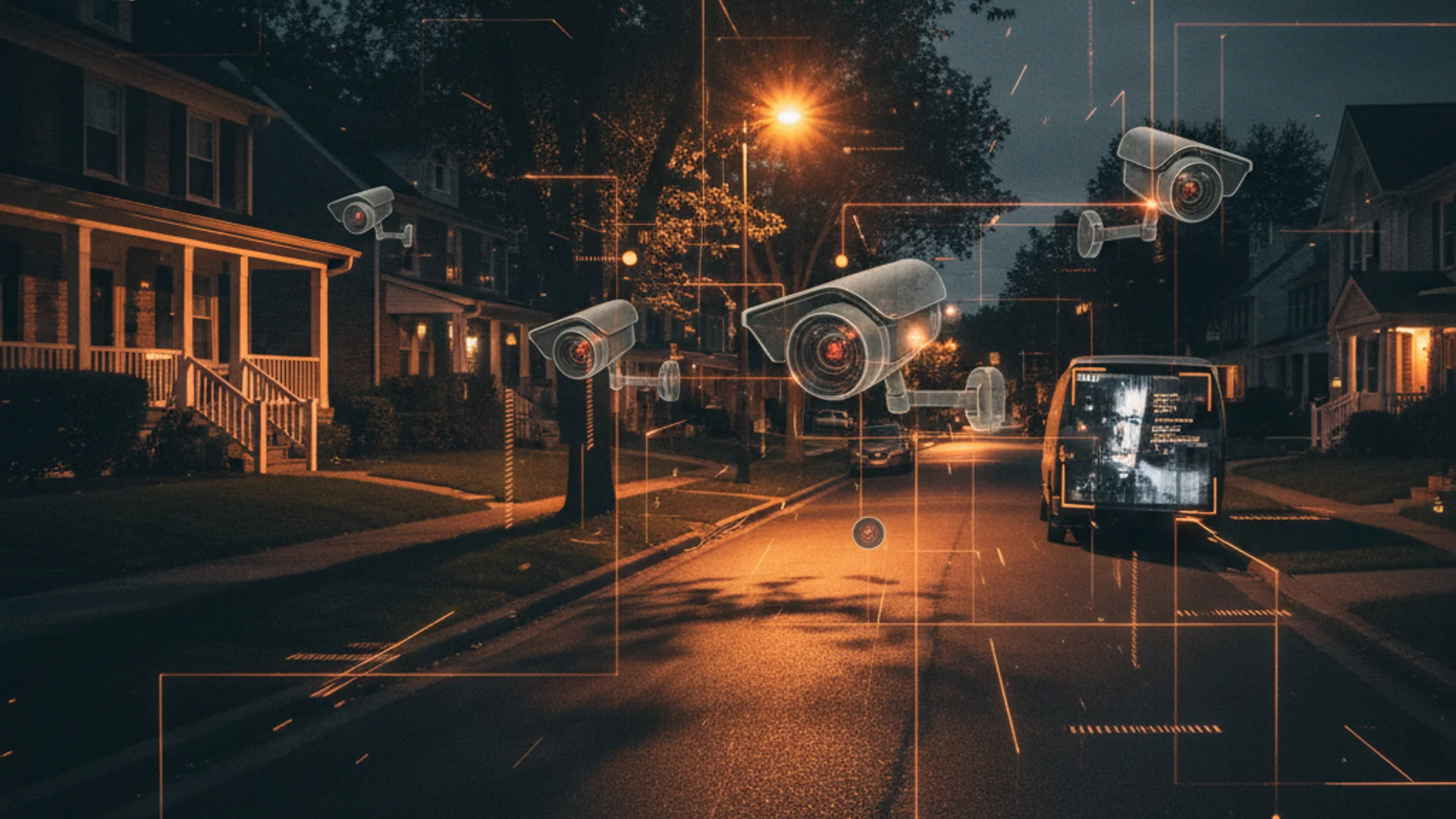
Your Ring doorbell isn't just recording package thieves anymore. It's feeding footage into a surveillance network that spans 2,161 police departments, processes millions of faces without consent, and keeps your videos forever—even if they contain zero evidence of crime. Amazon admitted to handing over footage to cops 11 times in 2022 without a warrant or your permission, citing "emergencies" that nobody but Ring and the police get to define. That was before they reversed course in 2025 and partnered with Flock Safety's license plate tracking system and Axon's real-time crime centers, reinstating the police pipeline they claimed to shut down a year earlier. Meanwhile, the Citizen app—the fear-monetization platform that started as "Vigilante" before Apple yanked it for being too dystopian—has convinced 10 million Americans to surveil their own neighborhoods while paying $20/month for a "digital bodyguard." In July 2025, New York City made it official: the NYPD now has direct access to user-submitted Citizen videos through a bidirectional data-sharing agreement. Your neighbor's paranoia is now evidence in a police database, and you're in the footage whether you consented or not. This isn't coming. It's here. The infrastructure is operational, the partnerships are signed, and Ring's "Familiar Faces" facial recognition feature launches in December 2025, scanning every face that approaches your camera—mail carriers, Girl Scouts, canvassers, the guy walking his dog past your house. None of them agreed to this. The question isn't whether you're being watched. It's whether you understand who's watching, what they're doing with it, and how to get out before your doorstep becomes a node in America's largest civilian surveillance grid.
The Network You Built For Them
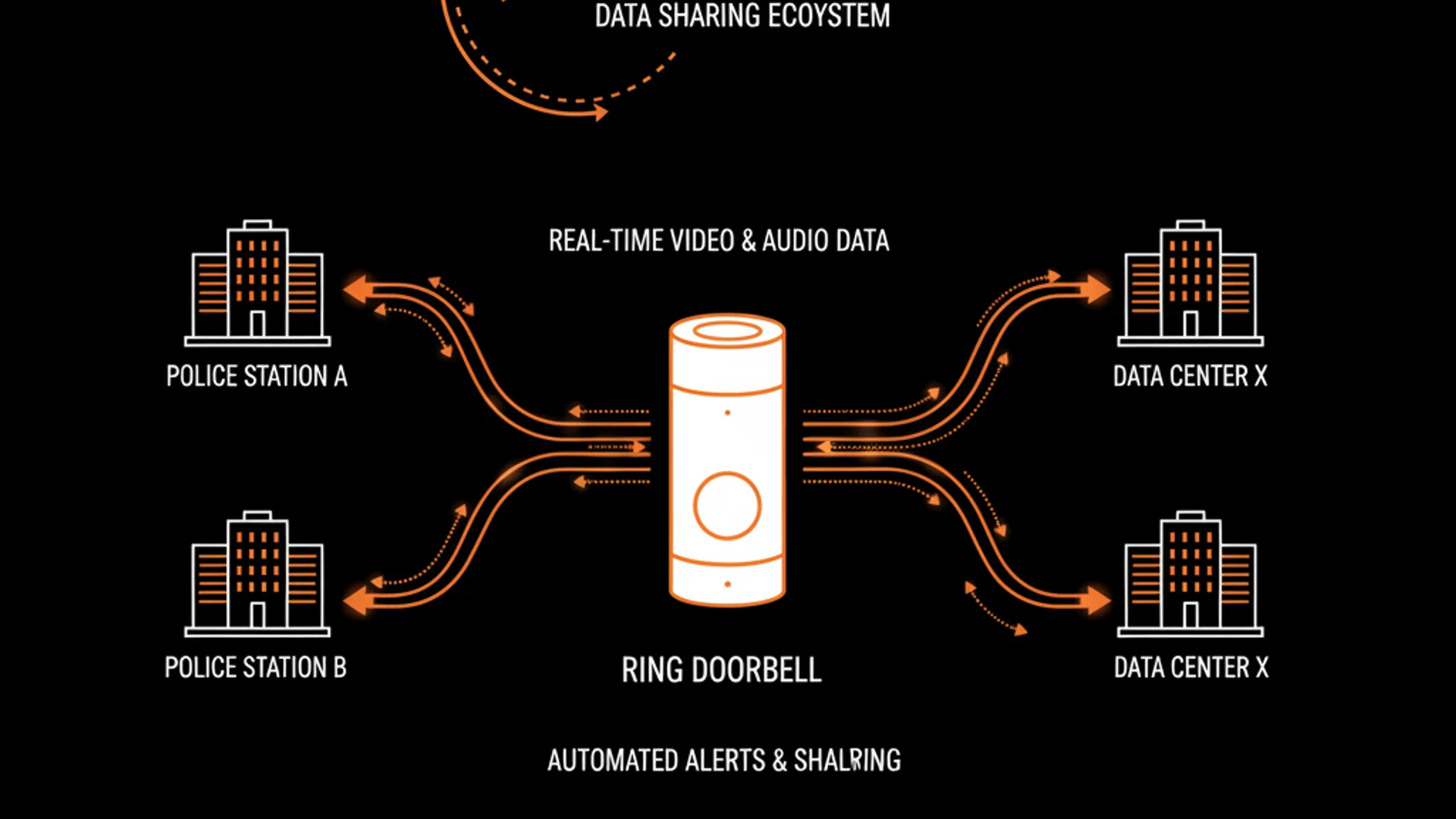
Ring didn't build a surveillance network. You did. They just sold you the cameras and called it security. By 2022, Ring had partnerships with 2,161 law enforcement agencies—more than five times the number from November 2019. That's nearly one in ten police departments nationwide with direct access to a system designed to let them request footage from your doorbell. Not from Ring. From you. Through the Neighbors app, cops could post requests like 'looking for footage from the 1400 block of Maple Street between 3-5pm on Tuesday,' and Ring would notify every user in range, nudging them to hand over their videos. No warrant. No court. Just a friendly request from your local PD, embedded in an app you thought was about porch pirates. The scale is staggering. More than 10 million Ring doorbells have been installed worldwide. That's tens of millions of cameras, all internet-connected, all streaming to Amazon's servers, all accessible to law enforcement through a system that treats your consent as a minor inconvenience. And when you don't consent? Ring's got a workaround. In response to Senator Ed Markey's investigation, Amazon admitted it shared footage with police 11 times in 2022 without a court order or owner permission because of 'emergencies' involving danger of death or serious injury. Sounds reasonable until you realize the people defining 'emergency' are Ring and the cops—two entities with precisely zero incentive to narrow that definition. The FTC wasn't buying it. In 2023, Ring paid $5.8 million to settle charges that it couldn't keep user footage private. The allegations were worse than the warrantless sharing: Ring gave employees unrestricted access to customer videos and ignored reports that some employees were secretly viewing footage.
Your bedroom, your kids, your private moments—watched by some contractor in a cubicle because Ring's internal controls were practically nonexistent. The settlement was a rounding error for Amazon. The admission was everything. In January 2024, Ring seemed to blink. Facing public fury, they dismantled the 'Request for Assistance' tool that let police solicit footage directly through the app. Authorities would now have to submit formal legal requests to Ring, not users. Privacy advocates celebrated. That celebration lasted eleven months. In 2025, Ring announced partnerships with Flock Safety and Axon, integrating doorbell cameras with automated license plate recognition systems and real-time crime center platforms. Translation: they rebuilt the police pipeline, but this time they cut you out entirely. Police don't need to ask you for footage when they can access the feed through a third-party data-sharing agreement with a company that already tracks every license plate in your neighborhood. The reversal wasn't a policy change. It was a business model upgrade.
Facial Recognition Comes to Your Front Porch
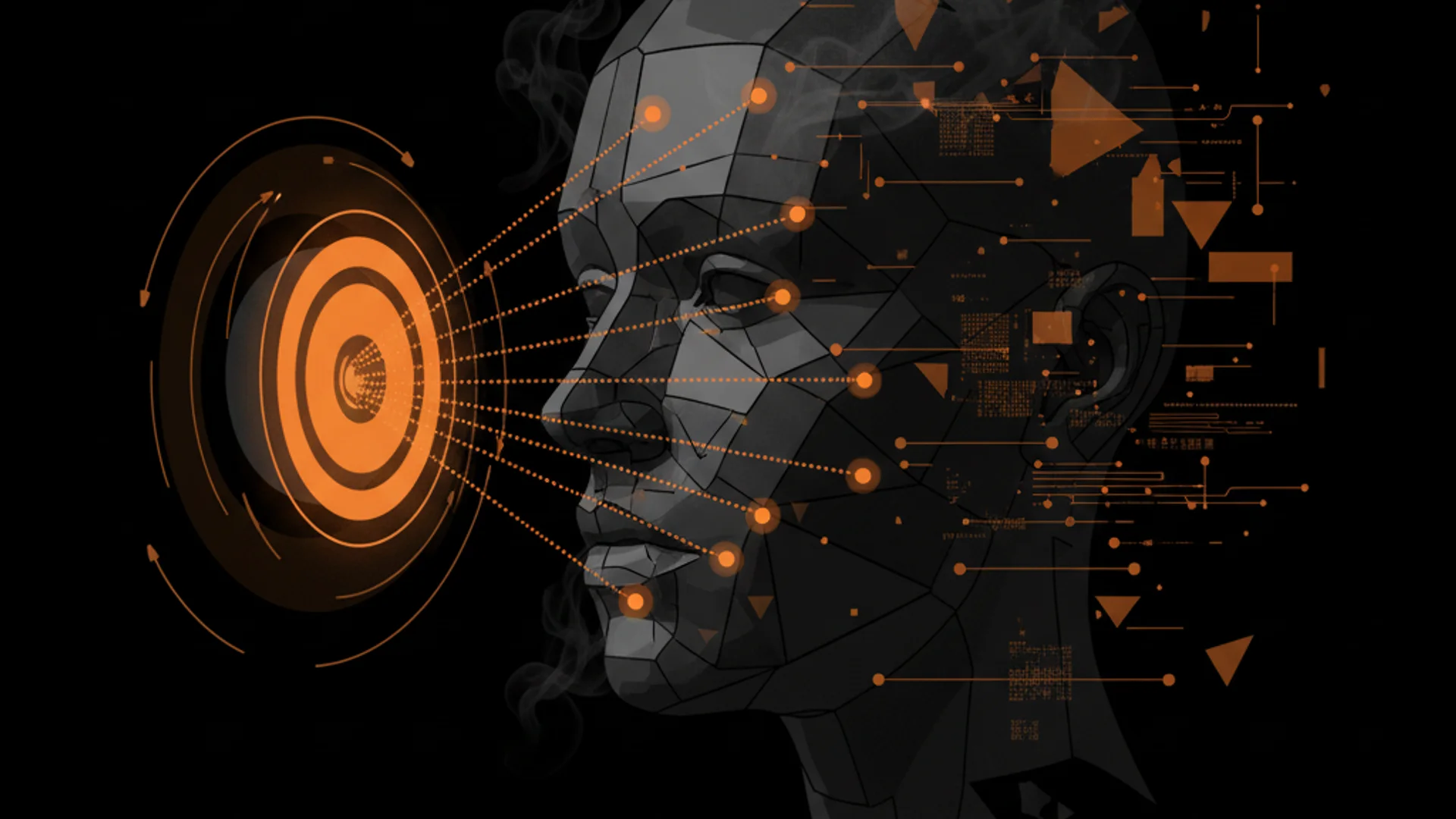
In December 2025, Ring will roll out 'Familiar Faces,' a facial recognition feature that scans every person who approaches your camera and tries to match them against a database of saved faces. Turn it on and your doorbell becomes a biometric checkpoint. Your mail carrier gets scanned. The kid selling fundraiser candy gets scanned. The person walking their dog on the public sidewalk in your camera's frame gets scanned. None of them consented. None of them were notified. None of them have any say in whether their face geometry gets logged in Amazon's system. This isn't speculative harm. It's documented legal exposure. Google paid $1.375 billion to settle a lawsuit in Texas over Nest cameras that 'indiscriminately capture the face geometry of any Texan who happens to come into view.' Facebook paid $650 million in Illinois and shut down its facial recognition tools. Meta paid another $1.4 billion to Texas after that. Ring is launching the same technology, in the same legal environment, with the same lack of consent from bystanders. They're just not making it available in Texas, Illinois, or Portland—because those places have laws with teeth. Everyone else is fair game. Senator Markey is demanding Amazon abandon the plan. His October 31, 2025 letter to CEO Andrew Jassy lays out the problem: this allows Amazon to collect biometric data on everyone who appears in front of a Ring camera, without consent, creating a distributed facial recognition database that law enforcement can tap. And they will tap it. Nathan Wessler of the ACLU warned that once police download Ring footage, they can run it through any facial recognition system they want—assuming they're in one of the many cities that hasn't banned the practice. Amazon told lawmakers in 2019 that police can keep Ring videos forever and share them with anyone, even if there's no evidence of a crime.
Now add facial recognition to that equation. Amazon has the technology. They paused direct sales of their Rekognition facial recognition system to police in 2020 after studies showed it had higher error rates identifying dark-skinned women. But they never disabled the system. The Department of Justice reportedly kept using Rekognition under contracts that sidestepped the moratorium. The infrastructure was always there. Ring's 'Familiar Faces' just makes it ubiquitous, distributed across millions of doorsteps, scanning faces in real time with no human oversight and error rates that disproportionately misidentify Black and brown faces. The same faces that Ring's Neighbors app has been profiling since launch, in posts that privacy researchers describe as a 'digital superhighway for racial profiling.' The app gives people the power to decide who looks suspicious and who belongs in their community, and study after study confirms those decisions are soaked in bias. Now you can automate the bias with facial recognition and call it a feature.
Citizen: The App That Monetizes Your Fear
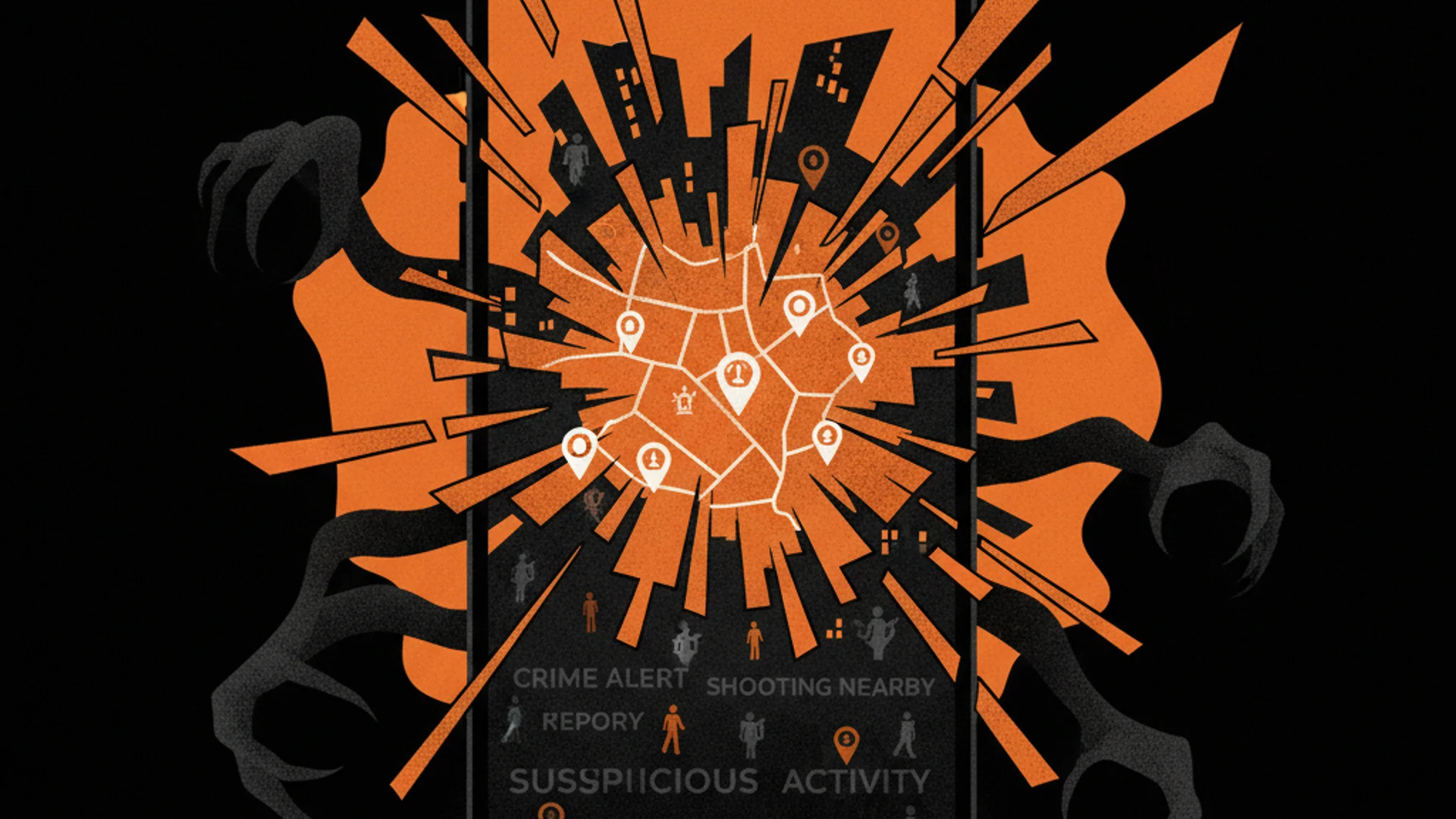
Citizen started as 'Vigilante,' an app that sent you push notifications every time a crime was reported near you, with the explicit goal of turning users into on-the-scene reporters. Apple pulled it from the App Store within 48 hours, citing safety concerns (because obviously). The company rebranded, raised $133 million in venture capital, and relaunched with the same model: flood your phone with incident reports, user-submitted videos, and breathless updates designed to make you feel like your neighborhood is a warzone. Then sell you a $20/month 'Protect' subscription for a 'digital bodyguard' who will... watch the same incidents on a screen and call 911 for you if things get scary. Former employees call it an 'anxiety sweatshop,' a workplace optimized to generate fear-inducing content at scale to drive subscriptions. Citizen boasts over 10 million users in the U.S., with around 3 million in New York City alone. That's 3 million people receiving real-time alerts about every arrest, every fire, every police call in their area, all formatted to spike your heart rate and keep you checking the app. It's not public safety. It's engineered anxiety with a subscription model. In July 2025, New York City made it official. The Adams administration launched 'NYC Public Safety,' an official Citizen account that creates a bidirectional data-sharing pipeline. The NYPD, FDNY, and NYC Emergency Management now have 'secure access to a dashboard for user-submitted videos to aid investigations and review incidents.' Translation: every video you upload to Citizen is accessible to law enforcement. No warrant required. You submitted it voluntarily, which means it's fair game. Your neighbor films a protest or a street argument or just a person they think looks 'suspicious,' and that video goes straight into a police database. Citizen's privacy policy is a horror show.
The app collects location data, copies of government IDs, COVID-19 diagnosis information, and undefined 'health information.' They commit to deleting Bluetooth data and government IDs in 30 days. Everything else? No regular deletion policy. It just piles up. The company has also integrated with Axon Fusus, a real-time crime center platform, allowing law enforcement to view live Citizen videos and push verified alerts directly to app users. You're not just surveilling your neighborhood anymore. You're part of a live-streamed panopticon where police can watch through your camera in real time. Citizen's entire business model depends on you believing your neighborhood is dangerous. The app isn't designed to give you accurate information—it's designed to keep you scared enough to pay. Studies have shown that exposure to constant crime alerts increases anxiety and distorts perception of actual crime rates, making people believe they're in more danger than they are. That's not a bug. That's the business model. And now it's integrated directly with NYPD surveillance infrastructure, turning every user into an unpaid sensor in a city-wide monitoring grid.
The Infrastructure Behind the Curtain
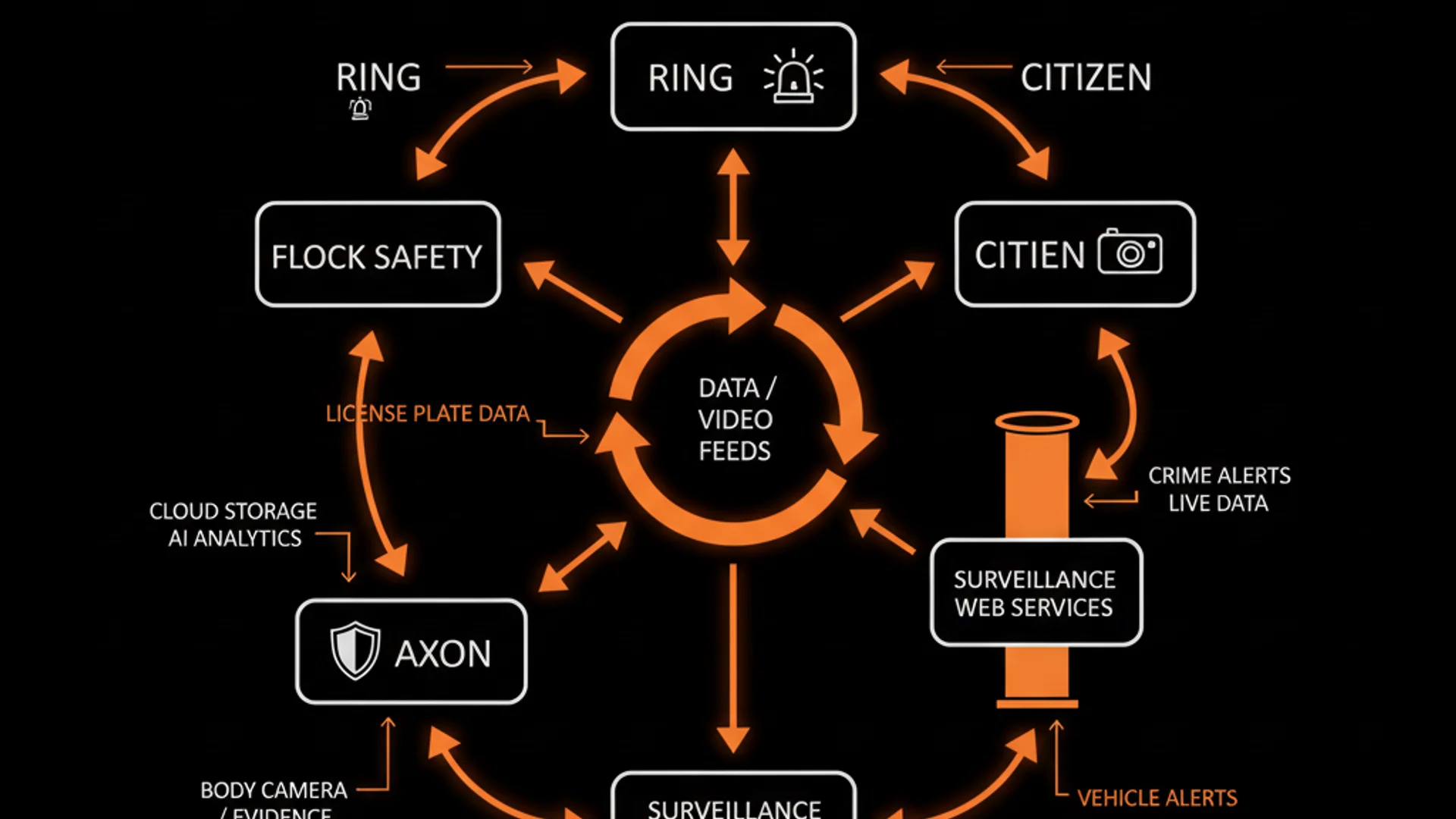
Ring and Citizen aren't isolated apps. They're nodes in a growing surveillance ecosystem built on Amazon Web Services, Flock Safety's license plate readers, Axon's cop-tech empire, and facial recognition tools that never actually went away. The Flock partnership is the clearest example: Ring's doorbell network now integrates with automated license plate recognition systems deployed in thousands of U.S. communities. Your doorbell sees a face. Flock's cameras—mounted on poles throughout your neighborhood—catch the license plate. Both data streams feed into the same system. Law enforcement gets a time-stamped package: face, plate, location, all linked. AWS is the connective tissue. Amazon isn't just hosting this data—they're actively selling it. Internal emails from West Coast law enforcement agencies reveal that AWS maintains a dedicated 'law enforcement and school safety' team that markets surveillance tools directly to police departments. Amazon has positioned itself as the broker for modern policing, offering cloud infrastructure, facial recognition, video storage, and analytics in one vertically integrated package. It's not a side business. It's strategy. Agencies like ICE already use Flock's systems. The data doesn't stay local. The 2025 Axon partnership completes the loop. Axon makes body cameras, Tasers, and Fusus—a real-time crime center platform that aggregates surveillance feeds into a single interface. Now Ring and Citizen footage flow directly into Fusus dashboards. A cop in a command center can watch your doorbell, a streetlight camera, a body cam feed, and live Citizen uploads on the same screen. They can scrub backward through timelines, run facial recognition queries, track vehicles, and identify people without ever stepping outside.
The warrant requirement—already flimsy—becomes irrelevant when the footage is voluntarily submitted or accessible through third-party partnerships. The legal frameworks haven't caught up. Amazon told lawmakers in 2019 that police can keep Ring footage forever and share it with anyone. There's no automatic deletion, no limits on use, no restrictions on who sees it downstream. Once your video enters the system, it's data. It can be run through facial recognition. It can be used to train AI models. It can be sold to other agencies or contractors. The terms of service you clicked through when you installed your doorbell don't protect you from any of this, because you agreed to let Ring share your footage under vague conditions that include 'cooperation with law enforcement' and 'compliance with legal requests.' Matthew Guariglia from the EFF summarized it: 'The problem is that the people deciding what constitutes exigent circumstances and what constitutes the type of emergency—all of these very important safeguards—are Ring and the police, both of whom don't have a great reputation when it comes to deciding when it's appropriate to acquire a person's data.' There's no judge. No oversight. Just a company with a financial interest in maintaining police partnerships and a police department with an institutional interest in accessing as much data as possible. Your doorbell is the price of entry.
What This Means for You, Specifically
If you own a Ring device, police in your city likely have access to request footage from it—or already have partnerships that let them pull it through intermediaries like Flock or Axon. If you use the Citizen app, your videos are accessible to law enforcement through data-sharing agreements, and in cities like New York, that access is official policy. If you walk past a Ring doorbell (and you do, constantly), your face is about to be scanned and logged starting in December 2025. You didn't opt in. You can't opt out. You're just data now. The second-order effects are worse. Facial recognition error rates are highest for Black and brown faces, particularly women. When these systems misidentify someone, the consequences aren't abstract—they're arrest, detention, interrogation. We already have documented cases of wrongful arrests based on facial recognition errors. Ring's 'Familiar Faces' will multiply those errors across millions of cameras with zero accountability, because the system isn't run by police departments with oversight boards—it's run by your neighbors, who have no training, no standards, and no liability when they flag the wrong person. This creates a distributed surveillance state where the infrastructure is privately owned, the data flows are opaque, and the accountability is nonexistent. You can't FOIA request footage from a private company the way you can from a police department. You can't vote out Amazon's CEO. You can't attend a city council meeting and demand Ring change its policies. The leverage points that exist in public governance don't apply here. You're subject to corporate terms of service, which can change anytime, and law enforcement partnerships that are negotiated in private with no public input. Even if you don't own these devices, you're in the system. Your neighbor's Ring catches you walking your dog.
A Citizen user films you at a protest. A Flock camera logs your plate when you drive to the grocery store. All of that data is stored indefinitely, cross-referenced with other databases, and accessible to police through partnerships you never consented to and likely don't know exist. Senator Markey said it plainly: 'It has become increasingly difficult for the public to move, assemble, and converse in public without being tracked and recorded.' This is the infrastructure that makes that tracking possible, and it's not government-run. It's subscription-based. The privacy policies confirm the nightmare. Ring's terms allow indefinite storage and sharing with law enforcement under broad conditions. Citizen collects location data, health information, and government IDs with no regular deletion schedule for most data types. Both companies reserve the right to change their policies at any time. You have no durable rights here. The deal can change tomorrow, and you'll get an email you won't read with an updated Terms of Service that you'll click 'Agree' on because the alternative is bricking a $200 device you already installed.
Frequently Asked Questions
Can I check if my local police department has a Ring partnership?
Ring used to maintain a public Active Agency Map showing police partnerships, but it's no longer reliably updated after the 2024 policy reversal. Your best bet is to file a public records request with your local police department asking for any agreements, MOUs, or data-sharing partnerships with Amazon Ring, Axon, or Flock Safety. Many departments will have to disclose these. You can also check local news archives—partnerships are sometimes announced in press releases that later get buried.
If I already own a Ring doorbell, what should I do right now?
If you want to keep using it, turn off the Neighbors app features immediately and disable all law enforcement sharing options in your privacy settings (Settings > Neighbors > Public Safety Alerts). Know that this doesn't prevent Ring from sharing footage under 'emergency' circumstances without your permission—that happened 11 times in 2022 that we know of. The only way to be certain your footage isn't accessible is to disconnect the device from the internet or replace it with a local-only security camera that doesn't stream to cloud servers. Brands like Eufy and Reolink offer local storage options with no police partnerships.
Does deleting the Citizen app remove my data from police databases?
No. Citizen's privacy policy doesn't commit to deleting most of the data they collect, and anything you've already uploaded—especially videos—has likely been accessed by law enforcement through data-sharing agreements. Once that footage enters police systems, it's retained according to their policies, not Citizen's. If you uploaded videos in NYC after July 2025, the NYPD has access to them through the official partnership. Deleting the app stops future data collection, but it doesn't undo what's already out there.
Is Ring's 'Familiar Faces' facial recognition coming to my state?
Ring plans to roll out 'Familiar Faces' in December 2025 everywhere except Texas, Illinois, and Portland, Oregon, because those jurisdictions have biometric privacy laws that make the feature legally risky. If you live anywhere else in the U.S., the feature is coming unless Ring faces additional legal challenges or regulatory action. The feature is opt-in for Ring owners, but if your neighbor turns it on, their camera scans your face without your consent every time you walk past.
Can police really keep Ring footage forever, even without evidence of a crime?
Yes. Amazon confirmed this to lawmakers in 2019. Once police obtain Ring footage—whether through a formal legal request, a voluntary user upload, or Ring's emergency exception process—they can store it indefinitely, share it with other agencies, run it through facial recognition systems, and use it however their internal policies allow. There's no automatic expiration, no requirement that it be tied to an active investigation, and no federal law limiting retention. Some states and cities have enacted their own limits, but most have not.
What's the safest alternative if I still want a doorbell camera?
Look for cameras that store footage locally (on a microSD card or a hub inside your home) with no mandatory cloud connection. Brands like Eufy, Reolink, and UniFi offer options with no subscription fees and no law enforcement partnerships. The tradeoff is you won't get remote access unless you set up your own VPN, and you're responsible for your own storage and backups. It's less convenient, but your footage stays in your physical possession and isn't accessible to anyone without physically accessing your storage device.
Are there cities or states banning this kind of surveillance?
Yes, but not many. San Francisco, Oakland, and Berkeley have banned city use of facial recognition. Boston and Portland (Oregon) have similar bans. Illinois and Texas have strong biometric privacy laws that require consent before collecting face geometry, which is why Ring won't launch 'Familiar Faces' there. But these are exceptions. Most jurisdictions have no meaningful restrictions on private surveillance networks or police use of third-party footage. If you want protection, you'll need to organize locally—city councils and state legislatures can pass ordinances and laws, but they won't do it without pressure.
Conclusion
This isn't a slippery slope. We're at the bottom. The surveillance infrastructure is operational, the partnerships are signed, the data is flowing, and the facial recognition rollout starts in December. The time to stop this was five years ago. The time to understand it is right now. Check your Ring settings today. Delete Citizen if you haven't already. If you live somewhere with a city council that listens, show up and demand they ban municipal use of facial recognition and restrict police access to private surveillance networks. Some cities have done it. Yours can too. If you want technology that doesn't surveil you, that works when the internet's down, and that doesn't feed your data into someone else's business model, that's why we're building SurvivalBrain. It's offline AI—no cloud, no data sharing, no partnerships with anyone. Base LLM plus ATLAS knowledge packs. Works during emergencies, respects your privacy, resists censorship. Launching Q1 2026, and early access is $149 (that's $50 off the $199 standard price). We're not building the panopticon. We're building the exit. Join the waitlist at https://survivalbrain.ai/#waitlist and get out before the cameras learn your face.
📚 Sources
- [1] Senator Ed Markey Letter to Amazon (October 31, 2025) - Senate inquiry on Ring facial recognition
- Establishes congressional oversight concerns and Amazon's admission of warrantless data sharing practices
- [2] Federal Trade Commission Settlement (2023) - FTC v. Amazon.com, Inc. (Ring)
- Documents $5.8 million settlement and findings on employee access violations and privacy failures
- [3] NBC News - 'Ring gave videos to police without owners' permission' (July 2022)
- Confirms 11 instances of warrantless access in first half of 2022 based on Ring's admission to Senator Markey
- [4] Ars Technica - 'Ring partners with Axon and Flock to revive police surveillance features' (2025)
- Breaks news of 2025 reversal reinstating police access after 2024 policy changes
- [5] Electronic Frontier Foundation - Matthew Guariglia statements on Ring and surveillance
- Provides expert privacy advocacy perspective on emergency exception loopholes and racial profiling infrastructure
- [6] The Washington Post - 'Ring's 'Familiar Faces' brings facial recognition to your doorstep'
- Details December 2025 rollout of facial recognition scanning all faces without consent of those captured
- [7] ACLU - Nathan Wessler testimony on surveillance multiplier effect
- Establishes how Ring footage can be used with third-party facial recognition systems by police
- [8] The Intercept - 'Citizen app investigation: Inside the anxiety sweatshop'
- Documents Citizen's business model monetizing fear, $133 million funding, and employee descriptions of workplace culture
- [9] NYC Mayor's Office - 'NYC Public Safety' Citizen account announcement (July 20, 2025)
- Confirms official city partnership with bidirectional data sharing between Citizen and NYPD/FDNY
- [10] Reuters - 'Google, Facebook, Meta biometric settlements in Texas and Illinois' (2022-2024)
- Establishes legal precedents: $1.375B Google, $650M Facebook, $1.4B Meta settlements for similar violations
- [11] CNBC - 'Ring and Flock Safety partnership analysis' (2025)
- Documents integration with automated license plate recognition systems deployed in thousands of communities
- [12] Amazon Ring Blog - 'An update on our Request for Assistance tool' (January 2024)
- Company's own announcement of discontinuing police request feature, establishing baseline for measuring 2025 reversal
- [13] NPR - 'Amazon's Rekognition and DOJ contracts sidestep moratorium' (2021-2023)
- Documents gap between Amazon's public 2020 pause and continued government facial recognition use
- [14] Motherboard - 'AWS law enforcement team emails reveal surveillance tech push to police'
- Internal documents showing AWS's dedicated team actively marketing surveillance tools to departments
- [15] Ring Active Agency Map and Neighbors Public Safety Service platform data (2019-2022)
- Provides hard numbers on law enforcement partnerships: 2,161 agencies by 2022, 5x increase since 2019
Get Early Access to Uncensored Offline AI
Join the waitlist for SurvivalBrain launching Q1 2026. Early supporters lock in $149 lifetime pricing (save $50).
Lock In $149 Pricing